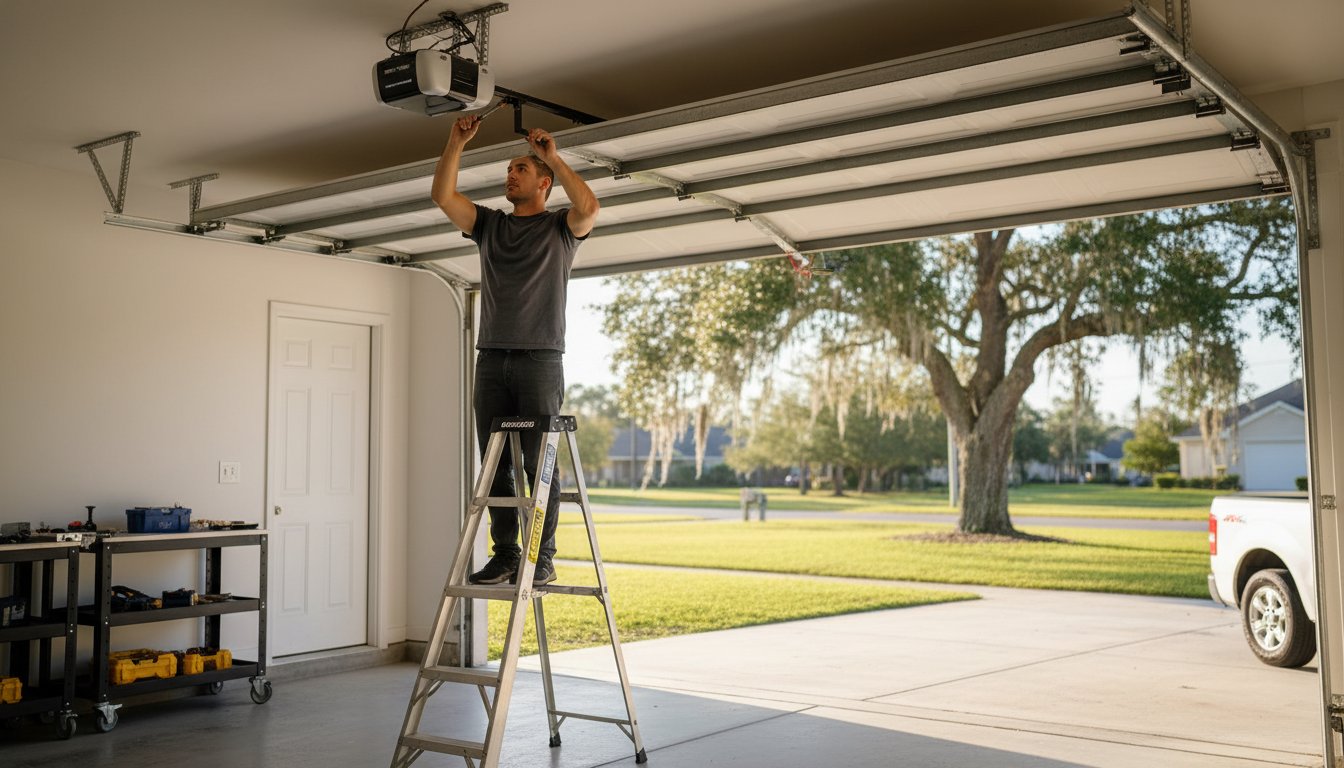
You're already running late for work when you press the remote button, hear a frustrating clicking sound, and realize your car is trapped behind a garage door that won't budge. In our Gulf Coast climate, this isn't always a simple mechanical failure. Often, it's the result of salt air and high humidity corroding sensitive components or warping the tracks over time. It's a stressful situation that leaves you worried about your family's safety and the potential for a massive repair bill.
We understand that you need a reliable solution that restores your peace of mind without the guesswork. This guide will help you identify the root cause of your system's failure and provide the clarity you need for garage door opener repair Pensacola residents can rely on. You'll learn how to distinguish between a quick DIY fix and a complex task that requires a professional. We'll also preview the latest LiftMaster technology and explain how to maintain your system against Florida's unique environmental challenges so you can avoid being stuck in the driveway again.
Key Takeaways
- Identify the specific red flags, such as intermittent reversing or grinding sounds, that indicate your motor or drive system is failing.
- Perform essential safety checks like the "Red Cord" balance test to determine if you need a professional garage door opener repair Pensacola technician.
- Apply the 10-Year Rule to evaluate whether a repair is a sound investment or if upgrading to a modern LiftMaster unit provides better long-term value.
- Gain peace of mind by understanding how standardized pricing and local expertise eliminate the stress of hidden fees and unreliable service.
Common Signs You Need Garage Door Opener Repair in Pensacola
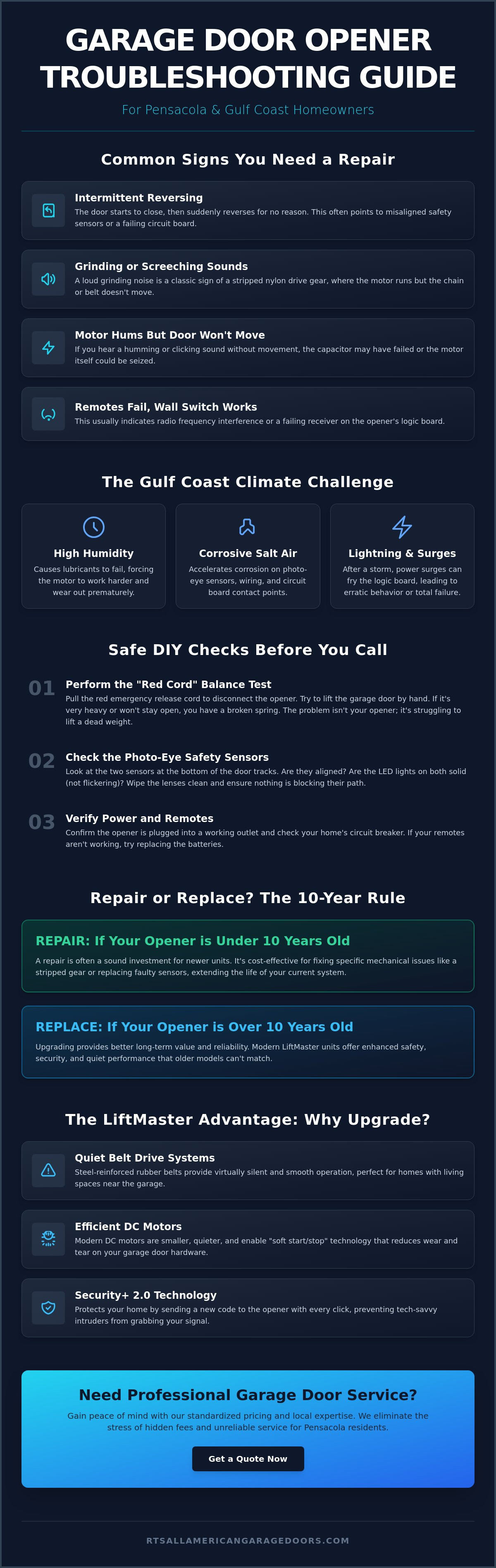
Identifying a failing opener starts with paying attention to small changes in how your door behaves. Intermittent operation is a classic red flag. If your door begins to close but suddenly reverses for no obvious reason, your opener's safety logic is being triggered. While this is often a sensor alignment issue, it can also point to a failing circuit board that can't process signals correctly. You shouldn't ignore these glitches, as they usually lead to a total lockout at the most inconvenient time.
Excessive noise tells a story of mechanical distress. A grinding sound usually indicates that the internal drive gear is being chewed up by the motor shaft. Clicking or humming without movement often means the capacitor has failed or the motor itself is seized. Since the History of the Garage Door Opener began in the 1920s, these systems have become more complex, but the basic mechanical stresses remain the same. When your wall switch functions perfectly but your remotes are dead, you're likely dealing with radio frequency interference or a dying receiver on the logic board. Conversely, if the remotes work but the wall station doesn't, the wiring between the opener and the wall is probably compromised.
Mechanical vs. Electrical Failures
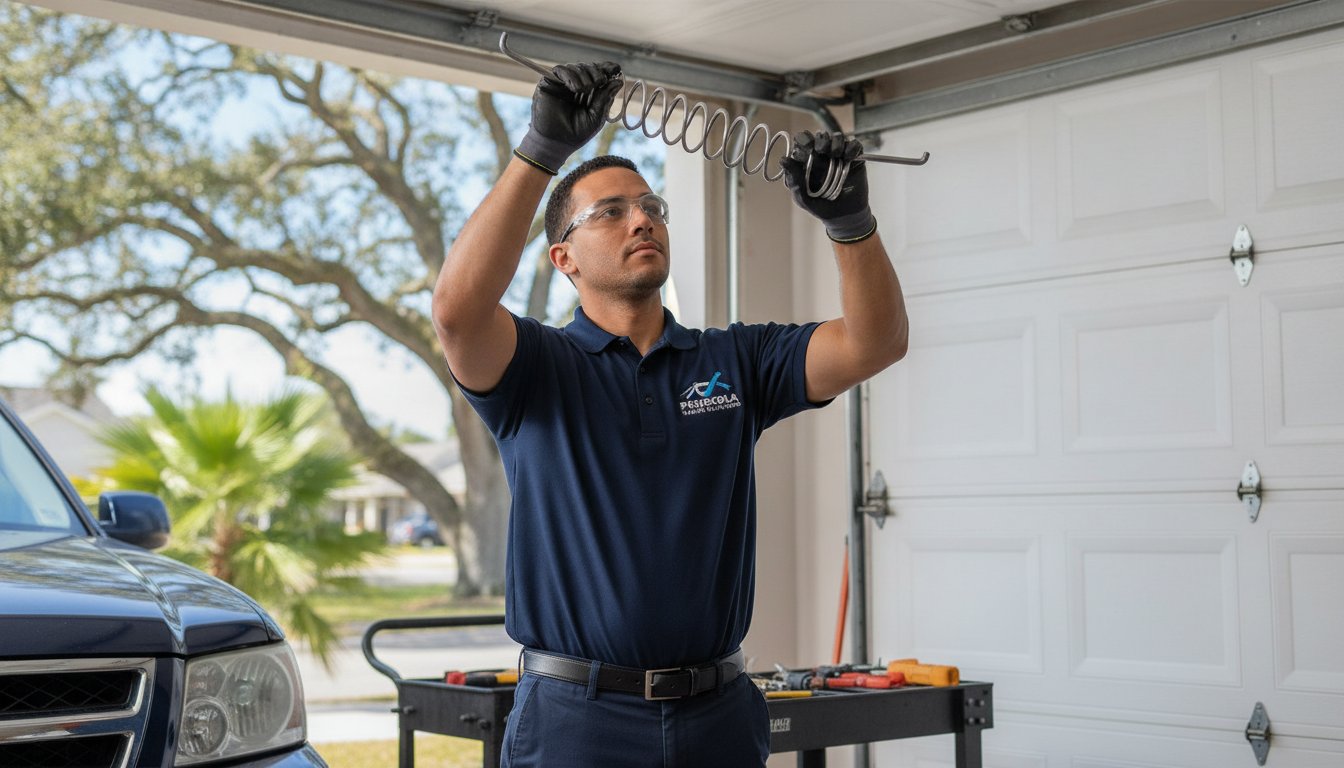
It's vital to know what you're looking at before you start a garage door opener repair Pensacola project. A stripped nylon drive gear is a common mechanical failure in older chain drive systems. You'll hear the motor running, but the chain won't move. Electrical failures are often more subtle. After a typical Gulf Coast lightning storm, a power surge can partially fry a logic board, leading to erratic behavior. Always check your door's balance first. If a torsion spring is broken, your opener isn't actually broken; it's just struggling to lift a dead weight it wasn't designed to handle.
The Impact of the Gulf Coast Climate
Pensacola's environment is notoriously harsh on machinery. High humidity can cause the specialized lubricants inside LiftMaster openers to gum up or lose viscosity, forcing the motor to work harder and wear out prematurely. Salt air is an even bigger threat. It accelerates corrosion on the thin copper wiring of your photo-eye sensors and can lead to oxidation on the circuit board contact points. During the peak of summer, condensation can build up inside the motor housing. This moisture causes short circuits that mimic a total system failure, making professional garage door opener repair Pensacola essential to diagnose the damage correctly.
Understanding Your Opener: How LiftMaster Technology Operates
A garage door opener is more than just a motor on a track; it's a sophisticated piece of machinery that balances heavy loads with precision electronics. At the heart of most modern units is the choice between AC and DC power. While older systems relied on bulky AC motors, modern LiftMaster units typically use DC motors. These are smaller, quieter, and allow for "soft start and stop" technology. This feature slows the door down as it reaches the top or bottom of its cycle, which reduces wear on your door's hardware and minimizes the need for frequent garage door opener repair Pensacola services.
The "brain" of the operation is the logic board. This circuit board coordinates everything from remote signals to the safety sensors located at the base of your door. Since 1993, Federal Safety Regulations for Garage Door Openers have mandated that all residential openers include a safety reversing system. This includes the photo-eye sensors that project an invisible beam across the opening. If that beam is broken while the door is closing, the logic board immediately halts the motor and reverses the door to prevent injury or property damage.
LiftMaster Belt vs. Chain Drive Systems
Choosing the right drive type depends on your home's layout and your tolerance for noise. Chain drives are the traditional workhorse, using a metal chain to pull the trolley. They're incredibly durable but can be noisy as the metal links vibrate. In the high-heat environments of Florida, chains require regular lubrication to prevent rust. Belt drives, however, use a steel-reinforced rubber belt. They're virtually silent and don't require the same level of messy maintenance. For homes with bedrooms located above or next to the garage, our team at RTS All American Garage Doors almost always recommends a belt drive for its smooth, quiet operation.
The Security+ 2.0 Advantage
Modern LiftMaster openers utilize Security+ 2.0 technology to protect your home from tech-savvy intruders. Older openers used fixed codes that could be easily "grabbed" by a device in the driveway. Security+ 2.0 uses rolling code technology, which changes the access code every time you click the remote. This ensures that the code used to open your door today will never work again.
Living on the Gulf Coast means preparing for unpredictable weather. Many of the 2026 LiftMaster models we install include integrated MyQ smart technology and battery backup systems. MyQ allows you to monitor and control your door from your smartphone, providing peace of mind when you're away from home. More importantly, the battery backup ensures that even during a hurricane-related power outage, you won't be trapped inside or forced to lift a heavy door manually. If your current unit lacks these modern safety features, it might be time to schedule a garage door opener repair Pensacola consultation to discuss an upgrade.
The Repair vs. Replace Dilemma: Making the Right Investment
Deciding whether to fix your current unit or start fresh is often the hardest part of the process. We use a straightforward "10-Year Rule" to help our neighbors make this choice. If your opener is over a decade old and requires a repair that costs more than half the price of a new unit, it's usually a sunk cost. Modern systems are significantly more energy-efficient and offer security features that older models simply can't match. You aren't just paying for a motor; you're paying for long-term reliability and the peace of mind that comes with a fresh warranty.
Safety is the most critical factor in this decision. If your existing unit was installed before 1993 and lacks photo-eye sensors, it doesn't meet the current federal consumer product safety standard. Keeping an outdated system isn't just a matter of convenience; it's a safety risk for your children and pets. Federal law has evolved to ensure these systems are as safe as possible, and running an obsolete unit ignores those vital protections.
You also need to consider your door's specific requirements. For instance, if you have Wayne Dalton classic steel doors, you need an opener with enough horsepower to handle the weight of wind-load reinforced panels. A mismatched opener will burn out its motor prematurely. This leads to another garage door opener repair Pensacola service call within months. We always ensure the opener's lift capacity matches the door's weight to prevent unnecessary strain on the mechanical components.
When to Choose Repair
Repairing your system is often the right move for minor component failures in units under seven years old. If the motor is still under warranty and the issue is a stripped drive gear or a blown capacitor, a repair is cost-effective. These are routine tasks for a garage door opener repair Pensacola expert and can usually be completed in a single visit. Simple wiring issues or sensor misalignments also fall into the repair category. If the bones of the machine are strong, we'll fix the specific part and get you back on track.
When Replacement is the Smarter Move
Replacement becomes the logical choice when the structural integrity of the unit is compromised. A cracked motor casing or a failing internal circuit board on an older unit can pose a fire risk. Obsolescence is another major factor. If your opener isn't compatible with modern smart home systems or lacks battery backup, you're missing out on essential Gulf Coast safety features. If you find yourself calling for service every few months, you're likely paying for a new unit one part at a time. It's better to invest in a reliable LiftMaster system that comes with a fresh warranty and modern security.
DIY Troubleshooting: Safe Steps Before Calling a Technician
Before you grab your ladder, prioritize your safety. Always unplug the motor unit before you inspect internal gears or logic boards. This prevents accidental activation while your hands are near moving parts. Next, perform the "Pull the Red Cord" test. By pulling the emergency release, you can manually lift the door to check its balance. If the door feels heavy or won't stay halfway open, your problem isn't the opener; it's likely a broken spring or worn rollers. Identifying these issues early helps you decide if you need professional garage door opener repair Pensacola or a simple DIY adjustment.
Don't overlook the simplest fix: batteries. If your wall button works but your remotes don't, replace the CR2032 or 9V batteries in your handheld units and wireless keypads. This is a common oversight that leads to unnecessary calls for garage door opener repair Pensacola services. If fresh batteries don't restore the signal, you may need to follow the manufacturer's instructions for remote control programming to resync the devices with the motor head. Check the wall station as well, as some modern units have a "Lock" button that accidentally disables remotes when pressed.
Testing the Photo-Eye Safety Sensors
Photo-eyes are the most frequent cause of a door that refuses to close. Start by cleaning the lenses with a soft cloth. In Pensacola, salt spray and dust build up quickly, blocking the invisible infrared beam. Check the LED lights on both sensors. One should be solid green and the other solid amber. If a light is flickering or dark, the sensors are out of alignment. Gently pivot the bracket until both lights glow steadily. Also, inspect the low-voltage wiring for loose staples or breaks caused by lawn equipment or pests. Even a tiny nick in the wire can cause the system to fail intermittently.
Adjusting Travel and Force Limits
If your door doesn't close all the way or reverses as soon as it hits the floor, you may need to adjust the travel limits. Look for the adjustment screws or buttons on the back of the motor unit. Turn them in small increments to set exactly where the door stops. To verify safety, perform the "2x4 Test" by placing a piece of wood flat on the ground in the door's path. The door must reverse immediately upon contact. Never increase the force settings to force a struggling door shut. This often masks a failing torsion spring, which can lead to a dangerous mechanical failure. If the door still won't behave after these adjustments, you can schedule a professional inspection to diagnose the underlying mechanical issue.
Professional Opener Repair Services in Pensacola & Baldwin County
RTS All American Garage Doors operates on a foundation of integrity. We believe you deserve to know exactly what you're paying for before the work begins. Our standardized pricing model eliminates the anxiety of hidden fees or surprise surcharges. When you call us for garage door opener repair Pensacola, you get a clear, honest assessment from a technician who values your time and your home's security. This transparency is our verbal handshake with the community.
We specialize in the mechanical and electronic nuances of LiftMaster, Chamberlain, and Genie systems. Our team doesn't just swap parts; we diagnose the system as a whole. Every service call includes a comprehensive safety inspection. We check your door's balance, test the auto-reverse system, and ensure the hardware is tightened to handle daily use. Our service area covers the entire region, including Pensacola, Gulf Breeze, Navarre, and Baldwin County, ensuring that expert help is never far away.
While our focus remains on the Gulf Coast, readers seeking similar high-quality expertise in other regions can explore Automatic Door Services from Liberty Door Repair to learn more about professional standards in door automation and safety.
Why Local Expertise Matters
Florida's building codes are some of the strictest in the nation. Our technicians understand the specific Florida Wind Load requirements that your garage door system must meet to keep your home protected during storm season. Being a family-owned business with over 15 years of experience means we've seen every possible failure. We know how urgent it is when your car is trapped inside. We prioritize quick response times for emergency situations because we understand that a broken opener is a major disruption to your day.
Scheduling Your Service
We respect your schedule. RTS technicians arrive on time, equipped with the necessary parts to complete most repairs in a single visit. We maintain clean workspaces and treat your property with the same care we'd give our own. Once the repair is finished, we'll walk you through the work performed and ensure you feel confident in your system's operation. Schedule your garage door opener repair in Pensacola today to get your system back to peak performance.
Get Your Garage Back on Track and Secure
A failing opener is more than a nuisance; it's a security risk that can leave your vehicles trapped and your family vulnerable. Throughout this guide, we've explored how to identify sensor glitches, the benefits of quiet belt drive technology, and when the 10-year rule suggests a replacement. By understanding these technical factors, you're better prepared to handle any garage door opener repair Pensacola needs that arise from our unique coastal environment. Ensuring your system is calibrated for Florida's conditions protects your investment and your peace of mind.
When the job requires professional expertise, RTS All American Garage Doors is here to help. As an Authorized LiftMaster Dealer with over 1,200 local customers and a 4.9-star rating, we specialize in high-quality garage door opener repair Pensacola. We utilize standardized, transparent pricing structures so you never have to worry about hidden costs or vague estimates. Get a Free Quote on garage door opener repair Pensacola and experience the reliability of working with a trusted local expert. Your home deserves a garage door system that works every time you press the button.
Frequently Asked Questions
Why is my garage door opener making a clicking noise but the door won’t move?
A clicking or humming sound usually indicates a failed start capacitor or a stripped internal drive gear. The motor is attempting to engage the drive system but lacks the electrical surge or the mechanical teeth required to move the trolley. If you hear the motor running but the chain or belt remains stationary, the drive gear is likely worn down and requires a professional replacement to restore function.
How much does it typically cost to repair a garage door opener in Pensacola?
The total cost for garage door opener repair Pensacola residents experience depends on the specific parts required and the age of the unit. While minor sensor realignments are less intensive, replacing a logic board or a motor involves more complex labor and hardware. We utilize a standardized pricing structure to ensure you receive a transparent quote without hidden fees once our technician completes a physical inspection of your system.
Can I replace my garage door opener myself?
While DIY installation is possible, professional replacement ensures your system is perfectly calibrated to your door's weight and meets Florida's wind-load safety standards. A professional technician guarantees that the safety reversing sensors are positioned correctly and that the motor's force settings won't prematurely wear out your door's hardware. This precision protects your warranty and ensures long-term reliability in our coastal climate.
Why does my garage door open halfway and then stop?
This issue is typically caused by an unbalanced door or improperly set travel limits. If the door's weight is not properly supported by the springs, the opener's safety logic will detect the excessive strain and stop the motor to prevent a burnout. You should pull the emergency release cord and try to lift the door manually; if it feels heavy or won't stay open, the problem is likely your springs.
How long do garage door openers usually last in the Florida climate?
Most residential openers last between 10 and 15 years, but Pensacola's salt air and high humidity can accelerate the corrosion of electronic components. Moisture often leads to oxidation on the logic board, while salt spray can degrade the lubricants on the drive chain. Investing in a high-quality LiftMaster unit and scheduling annual inspections can help you maximize the lifespan of your system despite these environmental challenges.
What should I do if my garage door opener was struck by lightning?
Unplug the unit immediately and inspect the motor housing for a burnt smell or visible scorch marks. Lightning surges often fry the sensitive circuit boards and the photo-eye sensors simultaneously. Because a surge can cause erratic behavior or create a fire hazard, don't attempt to force the unit to work. A professional should evaluate the system to see if a logic board replacement will suffice or if the motor is totaled.
Does my garage door opener need regular maintenance?
Yes, performing a basic safety check and lubrication once a year prevents small issues from becoming expensive repairs. You should lubricate the drive chain or screw drive, tighten the mounting brackets, and test the auto-reverse safety feature with a piece of wood. This proactive maintenance reduces the mechanical stress on the motor and helps you avoid an emergency garage door opener repair Pensacola service call during a busy week.
Why is my garage door remote not working even after changing the battery?
The remote may have lost its programming, or the wall station's "Lock" feature might be accidentally engaged. First, check the wall button to ensure the vacation lock isn't active, as this disables all radio signals. If the lock is off, you may need to follow the manufacturer's instructions to resync the remote with the motor's "Learn" button. In some cases, nearby LED bulbs can also cause signal interference.