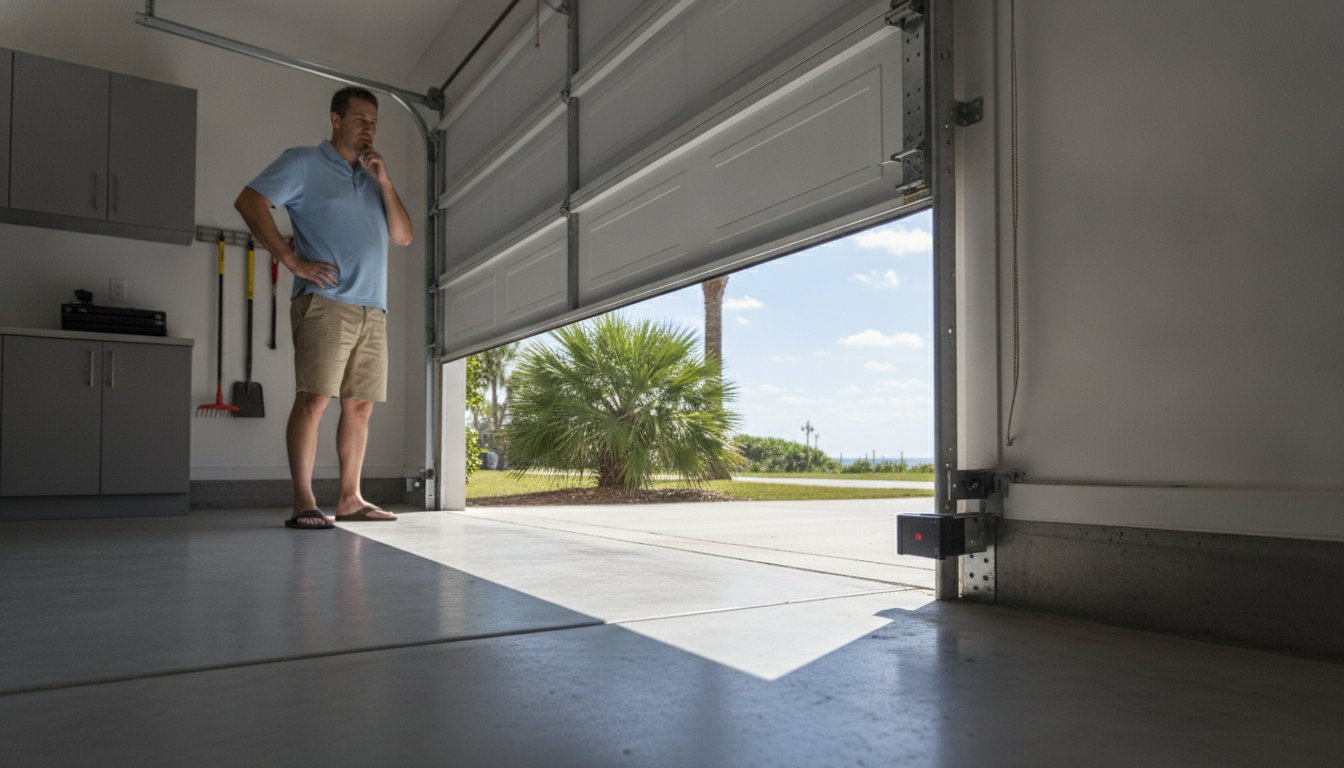
What if your garage door refusing to close isn't actually a mechanical failure, but your home's safety system doing exactly what it was designed to do? It's incredibly frustrating when you're trying to leave for work or lock up for the night and that door stops short or reverses. You're likely looking for a garage door won't close all the way fix because you're worried about your home's security and wondering if a simple blinking light is going to lead to an expensive repair bill. We understand that concern, especially with how the salty Gulf Coast air can wear down components faster than you'd expect.
Our goal is to help you identify the five most common culprits, ranging from simple lens obstructions to more complex track issues. You'll learn how to troubleshoot these problems safely, understand which fixes are DIY-friendly, and know exactly when you need a professional to step in. This guide ensures your door seals tightly against the floor again while keeping your family, pets, and budget protected.
Key Takeaways
- Identify common safety sensor and track obstructions to find a garage door won't close all the way fix without calling a technician.
- Learn how Pensacola’s high humidity and salt air accelerate track oxidation and roller wear, requiring specific maintenance steps.
- Distinguish between safe 10-minute homeowner adjustments and high-tension repairs that demand professional expertise for your safety.
- Discover how to correctly reset travel limits on LiftMaster and Wayne Dalton systems to ensure your door seals tightly against the floor.
- Understand why increasing motor force is often a temporary mask for deeper mechanical issues that require expert attention.
Immediate Troubleshooting: Why Your Garage Door Stops Just Before the Floor
It is a frustrating moment when you press the button, watch the door begin its descent, and then see it jerk back upward just inches from the ground. While this feels like a mechanical failure, it is actually the safety reverse system performing exactly as designed. Since 1993, federal law has required all residential openers to include these fail-safe features to prevent entrapment. Understanding the underlying garage door mechanics is the first step toward finding a garage door won't close all the way fix that doesn't involve an unnecessary service call.
Most modern systems, especially LiftMaster units, communicate their status through diagnostic codes. If your opener light bulbs flash ten times when the door reverses, the system is telling you it has a "photo-eye" error. Other times, you might deal with "nuisance" obstructions. A simple pebble in the track or a leaf stuck to the bottom weather seal can provide enough resistance to trigger the safety sensors. In the Pensacola area, we also see a unique issue called sunlight ghosting. During late afternoon hours, the intense Florida sun can hit the sensor lens at just the right angle to "blind" the infrared beam, tricking the motor into thinking a person or pet is in the path of the door.
The Role of Photo-Eye Sensors
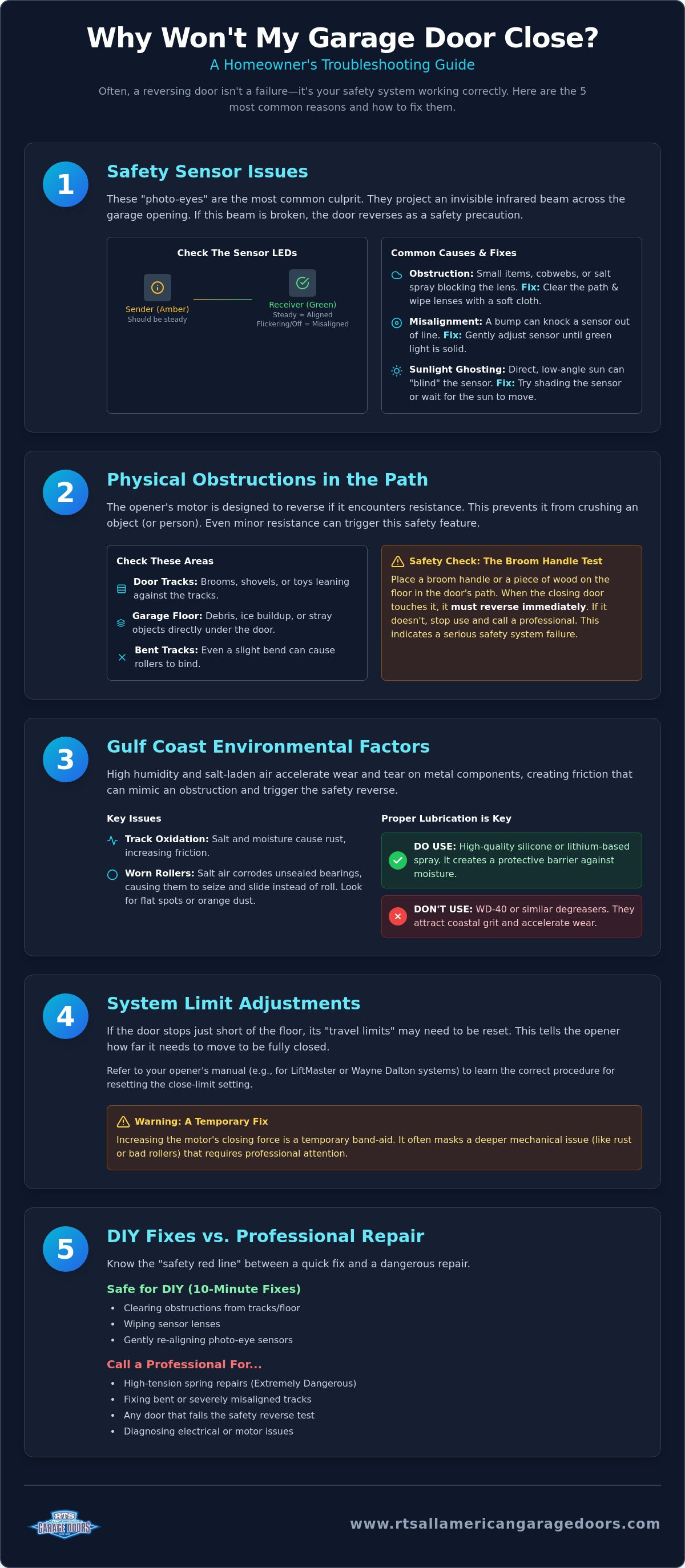
Your safety sensors are the "eyes" of your garage. One sensor sends an invisible infrared beam, while the other receives it. For the door to close, that beam must be unbroken. Check the small LED lights on each sensor located near the bottom of your tracks. Usually, one light is amber (the sender) and one is green (the receiver). Both should be glowing steadily. If the green light is flickering or dark, the sensors are misaligned. You can often fix this by gently tightening the mounting bracket or simply wiping the lens with a soft cloth to remove Gulf Coast salt spray or cobwebs.
Clearing the Path: Track and Floor Obstructions
Obstructions come in two forms: obvious and hidden. Check your vertical tracks for household items like brooms, shovels, or trash cans that might have shifted. Even a slight bend in the track can cause the rollers to bind, which the motor interprets as an obstruction. You should also inspect the garage floor for debris or ice build-up that prevents the door from reaching its full "close" position. To verify your system is working safely, perform the broom handle test. Place a sturdy object, like a piece of wood or a broom handle, on the floor in the door's path. When the door hits the object, it should reverse immediately. If it doesn't, you have a serious safety issue that requires a professional garage door won't close all the way fix to protect your family.
Mechanical Culprits: Tracks, Rollers, and the Gulf Coast Environment
Living along the Gulf Coast brings beautiful views, but it also presents a relentless challenge for your home's mechanical systems. The high humidity and salt-laden air in Pensacola and Baldwin County are primary drivers of oxidation. When your garage door tracks begin to rust, the resulting friction can easily trigger the safety reverse mechanism. This often leaves homeowners searching for a garage door won't close all the way fix, unaware that the culprit is actually microscopic salt crystals and moisture building up in the track's curves.
Wayne Dalton doors, known for their tight seals and aesthetic appeal, are particularly sensitive to hardware alignment. If the track shifts even a fraction of an inch due to the natural settling of Florida's sandy soil, the door may bind. This binding creates resistance that the opener interprets as an obstruction. Keeping these systems running smoothly requires a specialized understanding of how coastal weather interacts with heavy-duty steel and aluminum components.
Salt Air Corrosion and Hardware Wear
The rollers are the unsung heroes of your garage door system. In our environment, standard steel rollers with unsealed bearings are prone to seizing. Once salt air penetrates the bearing race, the roller stops spinning and begins to slide. This sliding action creates immense drag on the motor. You can identify this by looking for flat spots on the rollers or orange-tinted dust near the hinges. Many homeowners make the mistake of using generic degreasers like WD-40, which actually attract coastal grit and accelerate wear. Instead, focus on lubricating garage door springs and rollers with a high-quality silicone or lithium-based spray. These specialized lubricants create a moisture barrier that resists the corrosive effects of the Gulf breeze.
Misaligned or Bent Tracks
Your garage tracks must be perfectly "plumb" to function correctly. Over time, the vibration of the door combined with fluctuating temperatures can loosen the mounting bolts. A single loose bolt in the vertical track can cause the system to vibrate, leading the door to stop short. Look for visual cues like gaps between the rollers and the track or signs of scraping on the track's interior. If the door seems to struggle specifically as it enters the radius (the curved part of the track), you likely have a binding issue. While you can tighten visible bolts yourself, a full garage door track realignment is often necessary to ensure the door reaches the floor every time without straining the motor. This precision adjustment is a vital garage door won't close all the way fix that preserves the life of your expensive opener.
DIY Fixes vs. Professional Repairs: Understanding the Safety Red Line
Finding a garage door won't close all the way fix often starts with a search for a quick DIY solution. While we encourage homeowners to handle basic maintenance, it's vital to recognize the "Safety Red Line." The "Homeowner Green Zone" includes tasks like cleaning photo-eye sensors, lubricating rollers, or tightening a loose hinge bolt. These are safe, 10-minute fixes that anyone can perform. However, once you move beyond the tracks and rollers, you enter the "Professional Red Zone." Attempting to adjust high-tension components yourself can result in severe injury. Beyond the physical danger, unauthorized repairs on your Wayne Dalton or LiftMaster system can void manufacturer warranties, leaving you unprotected against future mechanical failures.
At RTS All American, we believe in integrity and transparency. Many companies provide vague estimates over the phone only to surprise you with hidden fees once they arrive at your home. We prioritize standardized pricing, providing a clear verbal handshake with every customer. This ensures you know the cost of your repair before the work begins. Our goal is to foster a sense of security and trust, ensuring your door is fixed right the first time without the stress of unexpected costs.
The Danger of Torsion and Extension Springs
A door that stops short might not have a sensor issue; it might actually have a broken garage spring. These springs act as the muscles of your door, counterbalancing hundreds of pounds of steel. The physics involved is simple but deadly. These components are under enough torque to cause lethal injuries if they snap during a DIY adjustment. You can perform a safe "balance test" by disconnecting the opener and lifting the door halfway. If it doesn't stay in place, the springs are worn or broken. Do not attempt to tighten them yourself. This is a job for a trained technician who has the proper winding bars and safety equipment.
Cables, Pulleys, and Structural Integrity
Cables and pulleys work in tandem with your springs to lift the door evenly. If you notice frayed steel strands or a cable that has slipped off the drum, your door's structural integrity is compromised. A door that feels unusually "heavy" is a clear sign that the tension system is failing, not that your motor is weak. If your system is struggling, it is time to call for Wayne Dalton garage door repair in Pensacola. Catching a frayed cable early prevents it from snapping and potentially trapping your vehicle inside the garage or causing the door to crash down unexpectedly.
Resetting Your System: A Guide for LiftMaster and Wayne Dalton Doors
When you have cleared the tracks and verified the sensors are clean, the issue might be digital rather than mechanical. Your garage door opener is essentially a computer that needs to know exactly where the floor is located. Over time, or after a power surge, these settings can drift. If you still need a garage door won't close all the way fix, it is likely time to recalibrate the travel limits. This process tells the motor exactly when to stop the downward motion to ensure a tight seal against the concrete.
One common mistake homeowners make is falling into the "Force Setting" trap. Most openers have a dial or digital setting to increase the force the motor uses to close the door. While it is tempting to turn this up to "push through" a stopping point, doing so is dangerous. If the door is stopping because of a mechanical bind, increasing the force can strip the internal gears or even bend the door panels. Always disconnect the trolley by pulling the red emergency release cord first. If you can't move the door easily by hand, do not adjust the force settings; you have a mechanical obstruction that requires professional attention.
Setting Travel Limits on a LiftMaster Opener
Modern LiftMaster units make this process straightforward. Locate the "Adjustment" buttons on the back or side of the motor head. Usually, these are two arrow buttons and a rectangular "set" button. Press and hold the "Adjustment" button until the "Up" arrow begins to flash. Once you've set the open position, press the "Adjustment" button again to make the "Down" arrow flash. Hold the "Down" arrow until the door reaches the floor and the weather seal compresses slightly. Press the "Adjustment" button one final time to lock it in. Always perform the safety reverse test mentioned in section one after any limit adjustment to ensure the system still protects your family.
Troubleshooting the Wall Console and Remotes
Sometimes the door won't close because of a simple setting on your wall station. Check if the "Lock" or "Vacation" button has been accidentally engaged; this feature prevents remotes from working while still allowing the wall button to function. Additionally, wireless interference from LED bulbs or nearby electronics can occasionally disrupt the signal from your keypad. If your system is over 15 years old and continues to lose its memory, it might be time to upgrade to modern LiftMaster garage door openers that feature encrypted signals and smartphone connectivity. For a reliable, long-term solution to your closing issues, contact our team for a professional system evaluation today.
Expert Garage Door Repair in Pensacola and Baldwin County
Troubleshooting at home is a great first step, but some issues require the precision of a trained technician. When a DIY garage door won't close all the way fix fails to solve the problem, it is usually because the system needs a professional track realignment or hardware optimization. RTS All American brings over 15 years of experience to the Gulf Coast, serving homeowners in Pensacola, Gulf Breeze, and Navarre with a commitment to traditional service values. We understand that a door that refuses to close is more than a nuisance; it is a security risk for your entire household.
We don't believe in faceless call centers or outsourced labor. When you call us, you speak with local experts who understand the unique stresses our coastal environment puts on your home. We prioritize integrity and transparency above all else. This means we use a strictly defined, standardized pricing structure so you know the exact labor rates and service costs before our boots hit your driveway. You won't find vague estimates or hidden surcharges here. We believe a verbal handshake should be backed by financial clarity and honest craftsmanship.
The RTS All American Difference
Our team specializes in the brands that stand up to Florida's humidity and stringent wind-load requirements. We recommend and install Wayne Dalton and LiftMaster systems because of their proven durability in coastal climates. With the 9th Edition of the Florida Building Code bringing stricter standards in late 2026, having a door that is properly aligned and reinforced is more important than ever. Whether it is a commercial overhead door or a residential carriage house model, we treat every system with high levels of care. We don't just patch the problem; we optimize the entire mechanical flow to ensure long-term value.
Schedule Your Professional Diagnostic
Preparing for a service call is simple and helps our technicians work efficiently. Clear the area around your door so our team can safely access the tracks, springs, and motor head. If you have noticed specific blinking light patterns on your LiftMaster opener or strange grinding noises, let us know when you schedule your appointment. Often, a comprehensive garage door tune-up service is all that is needed to prevent small friction points from becoming major mechanical failures. This proactive maintenance ensures your door seals perfectly against the floor every time.
Don't leave your home security or family safety to chance with a door that won't stay closed. Our disciplined approach to repair ensures your peace of mind and the continued reliability of your home's largest moving part. Contact RTS All American Garage Doors for expert repair today! We are ready to provide the reliable, neighborly service that has made us a trusted name in the community for over a decade.
Secure Your Home and Restore Your Peace of Mind
A garage door that stops short is more than just a daily annoyance. It leaves your home vulnerable and your family at risk. By checking your photo-eye sensors for alignment and clearing track obstructions, you can often find a garage door won't close all the way fix on your own. However, when the issue involves high-tension springs or complex travel limit resets, the safest choice is to call in the experts. Understanding the difference between a simple maintenance task and a dangerous mechanical failure is the key to long-term safety.
RTS All American is a family-owned and operated business with over 15 years of experience serving the Gulf Coast. As an authorized Wayne Dalton and LiftMaster dealer, we provide live, local technicians who answer every call personally. We take pride in our standardized pricing and professional integrity, ensuring you never face hidden costs or vague estimates. Don't let a malfunctioning door compromise your security or your schedule. Schedule Your Professional Garage Door Repair in Pensacola Now. We are ready to help you get your system back in top shape with the honest, reliable service you deserve.
Frequently Asked Questions
Why does my garage door open back up as soon as it hits the floor?
Your opener's travel limits are likely set too deep, causing the door to strike the floor with too much force. When this happens, the motor perceives the resistance as an obstruction and triggers the safety reverse mechanism to prevent damage. You can resolve this by adjusting the "down" limit on your LiftMaster or Wayne Dalton unit so the door stops exactly when the weather seal touches the concrete.
Can I bypass the garage door sensors if they are broken?
You cannot permanently bypass safety sensors because they are a federal safety requirement designed to prevent entrapment and injury. While you can override them temporarily by holding the wall button down until the door is fully closed, this is not a long-term garage door won't close all the way fix. Operating a door with broken sensors puts your family and pets at risk and should be addressed immediately by a professional.
How do I know if my garage door sensors are misaligned?
Check the LED indicator lights on the sensors located at the bottom of your tracks to verify their status. Typically, one sensor has an amber light and the other has a green light. If either light is flickering or completely dark, the sensors are misaligned or obstructed. Gently adjust the brackets until both lights glow steadily to restore the invisible infrared beam that allows the door to close.
Why does my garage door only close when I hold the wall button down?
This behavior is a built-in safety override that indicates your photo-eye sensors are either blocked, misaligned, or have a wiring fault. Holding the wall button tells the opener you are manually monitoring the door's path to ensure it is clear of people or objects. To restore normal remote and keypad operation, you must clear any obstructions or fix the sensor alignment issues described in our troubleshooting guide.
What does it mean when the lights on my garage door opener flash 10 times?
Flashing lights on a LiftMaster or Chamberlain opener are a specific diagnostic code indicating a problem with the safety sensor system. This signal usually means the sensors are misaligned, the wires are damaged, or the infrared beam is being blocked by an object. It is the system's way of telling you why it refused to close, pointing you directly toward a sensor-related garage door won't close all the way fix.
Is it safe to adjust the garage door travel limits myself?
It is generally safe for homeowners to adjust travel limits using the buttons or dials on the motor head. This process involves digital or mechanical limit settings rather than high-tension parts like springs or cables. However, you must always perform a safety reverse test afterward by placing an object in the door's path. If the door doesn't reverse upon contact, you need a professional to calibrate the system.
How much does it typically cost to fix a garage door that won't close in Pensacola?
Repair costs vary depending on whether the issue is a simple sensor realignment or a complex mechanical failure involving tracks or rollers. In Pensacola and Baldwin County, we prioritize integrity through standardized labor rates, so you know the cost before any work begins. Avoiding companies that provide vague estimates ensures you aren't overcharged for simple sensor fixes or basic track adjustments that restore your home's security.
Can salt air cause my garage door to stop closing properly?
Salt air is a primary cause of garage door failures along the Gulf Coast due to rapid corrosion. Corrosive salt crystals build up in the tracks and inside roller bearings, creating significant friction that the motor can't overcome. This resistance often triggers the safety reverse, preventing the door from sealing. Regular maintenance and lubrication with silicone-based spray are essential to combat the unique environmental wear found in our coastal community.