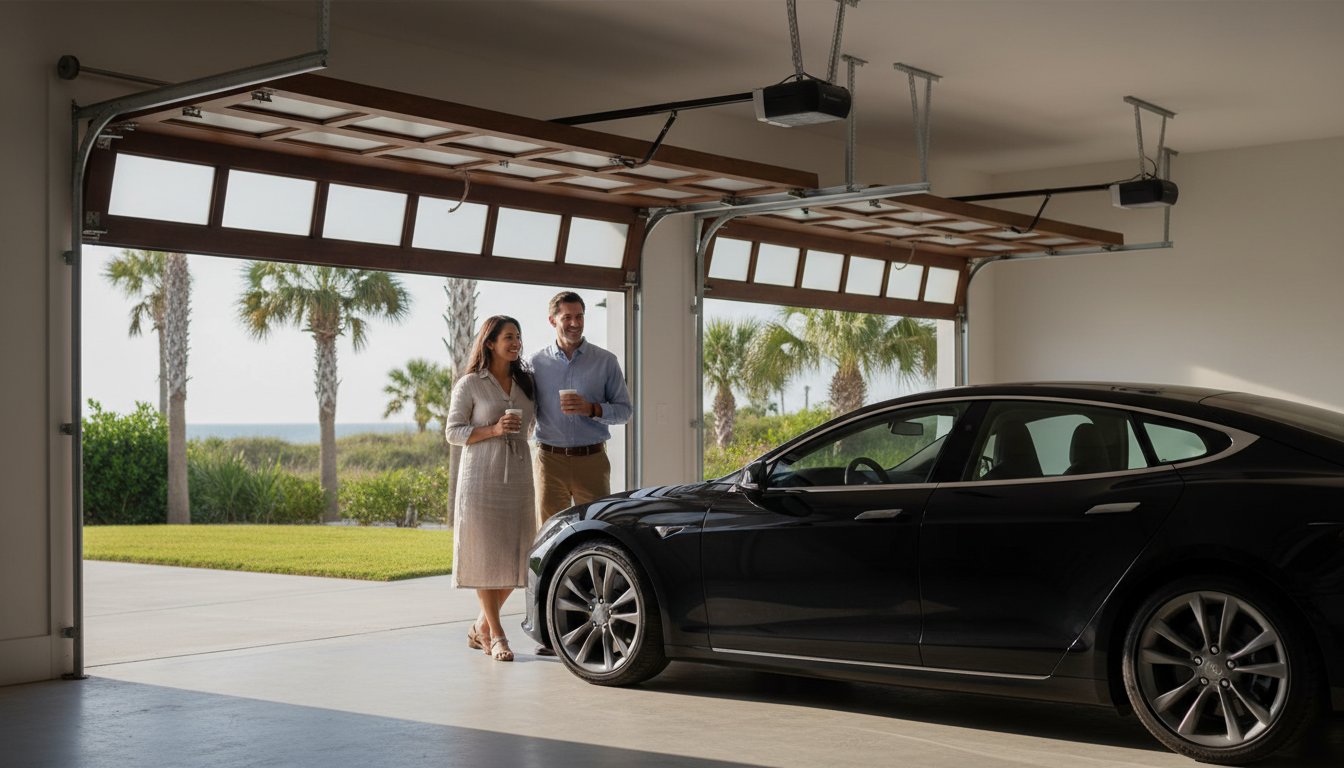
Imagine it's 6:00 AM and you're trying to leave for work without waking the kids, but your garage door sounds like a freight train screeching through the house. For many homeowners, this daily racket or the sight of a rusted chain caused by Gulf Coast humidity is a constant source of frustration. When you're deciding between a LiftMaster belt drive vs chain drive, you aren't just buying hardware; you're looking for a reliable way to keep your home secure and your mornings peaceful.
We know you want a system that's reliable, quiet, and smart enough to handle a heavy wooden door without breaking a sweat. This guide provides a comprehensive comparison of the 2026 LiftMaster lineup to help you find the perfect balance of noise control, power, and long-term durability. We'll preview the latest Security+ 3.0 technology and look at which models offer the 15-year lifespan your home deserves, ensuring you make an honest, informed decision for your garage.
Key Takeaways
- Identify the best opener for your specific home layout by applying the "Living Space" rule to minimize noise near bedrooms.
- Compare the performance and lifting power of a LiftMaster belt drive vs chain drive to ensure your motor handles heavy specialty wood or steel doors with ease.
- Learn how to protect your investment from Gulf Coast humidity and salt air corrosion through proper drive selection and routine maintenance.
- Understand the 2026 smart home standards, including MyQ integration and the security benefits of the new Security+ 3.0 communication frequency.
- Discover which drive system offers the best long-term value and reliability for a garage door system designed to last 15 years or more.
Understanding the Mechanics: How LiftMaster Belt and Chain Drives Operate
The drive system is the core component that determines your opener's performance. It works by transferring motor power to the trolley, which then pulls your door open or pushes it shut. While the motor provides the raw force, the drive system dictates the speed, sound, and smoothness of that movement. Choosing between a LiftMaster belt drive vs chain drive means deciding which mechanical method best suits your daily routine and your door's weight. Understanding how garage door openers work is the first step in making a smart investment for your home's long term value.
The Anatomy of a LiftMaster Chain Drive
Chain drives are the traditional workhorses of the industry. They use a heavy duty metal linkage, much like a bicycle chain, to move the trolley along the rail. A metal sprocket on top of the motor pulls this chain to create the necessary traction for lifting. Because this system relies on metal-on-metal contact, it requires regular lubrication to prevent friction and wear. It's a simple, effective design that has lasted for decades.
Maintaining proper tension is vital for these units. If the chain becomes too loose, it can develop "slack," leading to jerky movements or even jumping off the sprocket entirely. This mechanical simplicity makes them incredibly durable for heavy lifting. However, it also creates the characteristic "clinking" sound that many homeowners find disruptive, especially if the garage is attached to the house.
The Science of the LiftMaster Belt Drive
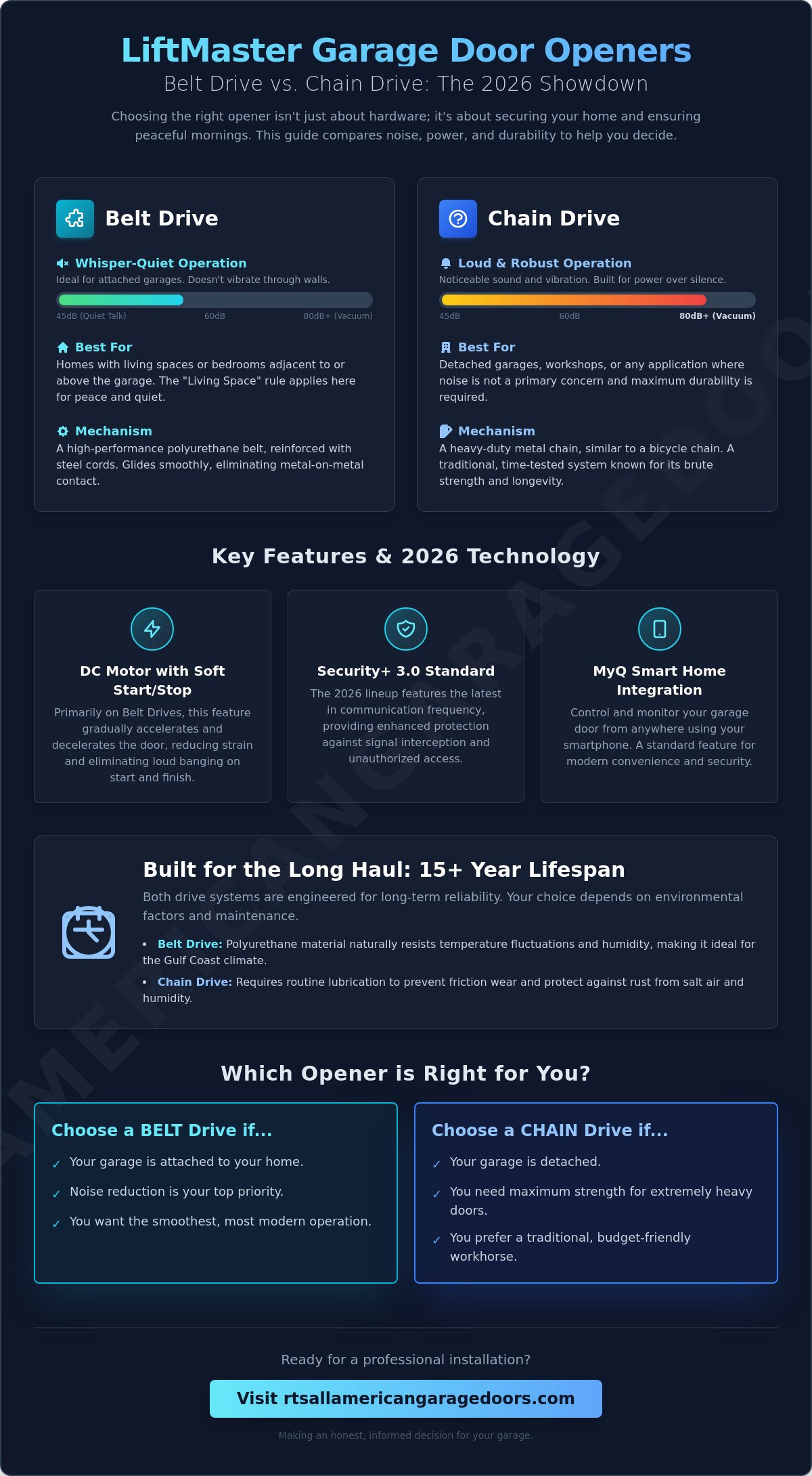
LiftMaster's belt drive systems replace the metal chain with a high performance polyurethane belt. This material is specifically engineered to resist temperature fluctuations. This is essential for maintaining flexibility during our hot, humid summers. To ensure the belt can handle heavy loads, it's reinforced with internal steel cords. This provides the tensile strength needed for larger doors without the weight or noise of a full metal chain.
The primary advantage of this design is the elimination of metal-on-metal vibration. The belt glides over the sprocket, providing a silent operation that won't vibrate through the walls of your home. When comparing the LiftMaster belt drive vs chain drive, the belt's ability to dampen sound makes it the clear winner for bedrooms located above or next to the garage. It offers a refined, quiet experience without sacrificing the power needed to lift a Wayne Dalton Classic Steel door.
Both systems are built for long term reliability, but they serve different needs. A chain drive offers brute strength for detached garages or workshops. A belt drive provides a premium, quiet solution for modern residential living. Your choice ultimately depends on where your garage is located and how much you value a quiet morning.
Performance Showdown: Noise Levels, Lifting Power, and Speed
When you compare a LiftMaster belt drive vs chain drive, the performance difference is felt the moment you press the button. Most homeowners prioritize noise levels, especially if the garage sits directly below a bedroom or nursery. A typical belt drive operates between 45 and 60 decibels. This is roughly the volume of a quiet conversation. In contrast, chain drives usually run between 60 and 80 decibels. That is comparable to a vacuum cleaner running inside your garage. This sound isn't just air movement; it's the vibration of metal links traveling through the structure of your home.
The Quiet Factor: Belt Drives and DC Motors
LiftMaster achieves this silence by pairing their belt systems with advanced DC motors. These motors allow for a "soft start and stop" feature. Instead of the door jerking into motion, the motor gradually ramps up speed and slows down before reaching the floor. This significantly reduces the strain on your door's hardware and eliminates the loud "bang" that occurs when a door finishes its cycle. For attached garages, this vibration isolation is essential for maintaining a peaceful home environment.
Every residential opener must also meet strict federal safety standards regarding entrapment protection and remote operation. LiftMaster ensures that both drive types include these safety sensors and audible alerts. If you're tired of a noisy system waking up the house, our team can provide professional garage door opener installation to restore the quiet.
Strength and Reliability for Heavy Doors
There is a common myth that belt drives lack the strength to handle heavy doors. This is simply not true with modern engineering. While chain drives are the traditional choice for oversized commercial overhead doors or heavy industrial applications, a high quality belt drive can easily manage a Wayne Dalton Specialty Wood door. LiftMaster's belt models are reinforced with internal steel cords to prevent stretching and ensure maximum tensile strength. They offer the same lifting capacity as chain models, often rated for doors weighing several hundred pounds.
Chain drives still have their place, particularly in detached garages or workshops where noise isn't a concern. They utilize a rugged I-beam rail system designed for maximum rigidity. This makes them a great choice for high traffic areas or very large double car doors. We recommend evaluating your specific needs based on these factors:
- Living Space: Use a belt drive if bedrooms are adjacent to the garage.
- Door Material: Both drives handle steel doors well, but belts offer a smoother experience for custom wood.
- Maintenance: Chains require more frequent lubrication to stay quiet and functional.
- Speed: Both systems generally operate at a standard rate of 7 to 9 inches per second.
The choice between a LiftMaster belt drive vs chain drive ultimately comes down to your tolerance for noise and your garage's location. Both systems provide the reliability you expect from a premium brand, but the belt drive offers a more refined, modern experience for the average family home.
Durability in the Gulf Coast Climate: Maintenance and Lifespan
Living in Pensacola or Gulf Breeze means your garage door hardware is constantly fighting moisture. When comparing a LiftMaster belt drive vs chain drive, you have to look beyond the motor. You need to consider how salt air and humidity affect the moving parts over a decade of use. While both systems are engineered for durability, our local environment puts unique stress on metal components that homeowners in drier climates never have to face.
A chain drive is a classic choice with a long track record of reliability. These units often last 15 to 20 years if you stay on top of maintenance. However, the metal links are prone to rust and binding in our coastal air. If you prefer a belt or chain garage door opener that handles the humidity with less fuss, the polyurethane belt is the modern standard. It typically lasts 10 to 15 years but won't corrode like steel links.
Combating Rust in Pensacola and Baldwin County
Coastal moisture is a silent killer for garage door openers. For homeowners in Pensacola Beach or Navarre, chain lubrication isn't optional. You should apply a high quality silicone lubricant every six months to keep the links from binding or oxidizing. Belts don't have this problem. They stay flexible without oil, which prevents the messy "black rain" of grease that can sometimes drip from a neglected or over-lubricated chain drive.
Signs of drive fatigue differ between the two systems. For a chain, you'll see orange staining or hear a rhythmic "slap" against the rail. For a belt, fatigue shows up as small cracks or fraying along the edges. Catching these issues early prevents a total system failure during a storm when you need your garage to be most secure.
Routine Maintenance for Maximum Life
Even a low maintenance belt drive needs a professional eye once a year. We check the internal steel reinforcement cords for fraying and ensure the tension is correct. For chains, we look for rusted pins that could snap during a heavy lift. Regardless of which system you choose, high humidity can trap moisture inside the motor casing, potentially damaging the logic board.
Schedule an annual inspection with RTS All American Garage Doors to check your torsion springs and electronic components. This simple step protects your investment and ensures your door opens every time you hit the button. We'll help you keep your system running smoothly for its entire expected lifespan, no matter how much salt is in the air.
Smart Features and Security: The Role of MyQ and Battery Backup
A common question we hear is whether choosing a LiftMaster belt drive vs chain drive limits your access to modern technology. The good news is that for the 2026 lineup, LiftMaster has standardized smart features across both platforms. Whether you prefer the rugged strength of a chain or the whisper quiet operation of a belt, you'll receive the same high level of digital security. Both systems now utilize Security+ 3.0 technology. This advanced encryption prevents "code grabbing," where hackers attempt to intercept your remote signal to gain entry to your home. It's a professional standard that provides peace of mind for every family we serve.
MyQ Connectivity and Real-Time Alerts
The MyQ app has changed how homeowners in Mobile and Pensacola manage their daily routines. You no longer have to turn the car around because you can't remember if you closed the garage door. The app provides real-time alerts directly to your smartphone whenever the door is activated. You can also set custom schedules to ensure the door automatically closes at a specific time every night. This is a simple, honest way to keep your home secure without a second thought.
For those who frequently shop online, these openers integrate with Amazon Key. This allows delivery drivers to place packages safely inside your garage, protecting them from porch pirates and our frequent Gulf Coast rain showers. While core functions like remote opening are free, advanced features like geofencing or guest access now require a MyQ Premium subscription, which costs $35 per year as of May 2026. If you're ready to upgrade your home's security, we offer flat-rate garage door opener installation with no hidden fees.
Power Outage Protection
During the Gulf Coast storm season, power outages aren't just an inconvenience; they're a safety concern. When a hurricane or severe tropical depression knocks out the grid, a standard opener becomes dead weight. This is why battery backup is a critical feature for any local installation. While California law mandates these systems, we believe they are essential here in Alabama and Florida too. You don't want to be stuck manually lifting a heavy door in the middle of a storm.
High end belt drive models, such as the 87504-267, often lead the way in integrated technology. This specific model features a built-in 1080p camera and a powerful battery backup system that allows for multiple cycles even when the main power is out. Many of our heavy duty chain models also offer battery backup as a standard or optional feature. The drive type doesn't dictate your safety. Instead, it's about choosing the specific model that fits your family's emergency preparedness plan. We'll help you pick a reliable unit that ensures you're never locked out when it matters most.
Making the Right Choice: Matching Your Opener to Your Garage Door
Choosing between a LiftMaster belt drive vs chain drive isn't just about picking a motor. It's about matching mechanical tension to your door's weight and your home's layout. We always tell our neighbors across Pensacola, Gulf Breeze, Navarre, and Baldwin County to start with the "Living Space" rule. If your garage is attached and sits next to a nursery or below a master bedroom, the noise levels of a chain drive will eventually become a headache. However, if you have a detached workshop where noise doesn't matter, a chain drive provides raw durability and a steady performance for a lower upfront cost.
Your door material also dictates the best fit. A Wayne Dalton Classic Steel door is relatively lightweight and works beautifully with either system. But if you've invested in a heavy Wayne Dalton Specialty Wood door, you need a drive system that can handle the high tensile load without struggling. Modern LiftMaster belts are reinforced with steel to handle this weight, but many homeowners still prefer the traditional rigidity of a chain for massive custom wood doors. Every garage is different, and we take pride in helping you find the honest solution that fits your specific setup.
When to Choose a LiftMaster Belt Drive
We recommend the belt drive for any attached garage. It's the ideal pairing for the Wayne Dalton 8300 insulated steel door. These doors are designed for energy efficiency and quiet operation; a belt drive completes that premium experience. You'll spend less time on maintenance since the polyurethane belt doesn't require the frequent oiling that metal chains do. It's a high-tech, low-friction solution for modern living that provides a quiet garage environment every single morning.
When to Choose a LiftMaster Chain Drive
A chain drive remains the go-to for detached garages, workshops, or high-cycle commercial use. If you want to prioritize raw durability and mechanical strength, the chain drive is a reliable workhorse. It handles the weight of solid wood or carriage house steel doors with ease. While it requires more frequent lubrication to prevent rust in our Gulf Coast humidity, the metal-on-metal linkage provides a level of mechanical strength that has been trusted for over 50 years. It's the practical choice for homeowners who want a dependable system that lasts 15 to 20 years.
Expert Installation Across Pensacola and Baldwin County
Selecting the right opener is only half the battle. A poor installation can make even the quietest belt drive sound like a rattle-trap. At RTS All American Garage Doors, we provide a fixed-price installation model. You'll know exactly what you're paying for labor and parts before we even start the job. Our local technicians understand how the salt air affects your tracks and rollers, ensuring your new system is calibrated for the long haul. We don't believe in hidden fees or vague estimates; just quality American service you can trust. Schedule your LiftMaster installation with RTS today!
Invest in a Reliable Garage for Your Gulf Coast Home
Choosing the right opener is the final step in ensuring your garage functions as a safe and quiet extension of your home. Whether you prioritize the near-silent operation of a belt or the rugged lifting capacity of a chain, your choice between a LiftMaster belt drive vs chain drive shouldn't be a guessing game. It's about matching the hardware to your home's layout and our unique local climate. Remember that while belts offer lower maintenance in our humid environment, a properly lubricated chain remains a durable workhorse for detached shops.
With over 15 years of local experience, RTS All American Garage Doors is your authorized dealer for both LiftMaster and Wayne Dalton products. We believe in total transparency; that's why we offer fixed-price installation with no hidden fees or surprise surcharges. Our technicians understand the specific challenges of salt air and high humidity. We ensure your system is calibrated perfectly for the long haul.
Get a Free Quote on Your New LiftMaster Opener today and enjoy the peace of mind that comes with a professionally installed, high-performance system. We look forward to helping you upgrade your home with honest service and reliable craftsmanship.
Frequently Asked Questions
Is a LiftMaster belt drive stronger than a chain drive?
Modern LiftMaster belt drives are just as strong as chain drives for most residential applications. While chain drives were historically the heavy duty choice, current belt models feature internal steel cord reinforcement. This provides the tensile strength needed to lift even heavy double car doors. Only in extreme commercial or oversized industrial settings does the chain drive offer a distinct advantage in raw pulling power for continuous daily use.
How much quieter is a belt drive garage door opener really?
A belt drive is significantly quieter, operating at a volume of 45 to 60 decibels. For comparison, a chain drive typically runs between 60 and 80 decibels. This is the difference between a quiet conversation and a loud vacuum cleaner. When comparing a LiftMaster belt drive vs chain drive, the belt's ability to eliminate metal-on-metal vibration makes it the superior choice for homes with attached garages or bedrooms nearby.
Do LiftMaster belts ever break or snap?
It is extremely rare for a LiftMaster belt to break or snap under normal operating conditions. These belts are made of high grade polyurethane reinforced with internal steel cords for maximum durability. Unlike older rubber belts that could dry out and crack, modern polyurethane is designed to withstand the heat and humidity of the Gulf Coast. Most belts are rated to last at least 10 to 15 years without failure.
Can I replace my old chain drive with a new belt drive opener?
Yes, you can replace an old chain drive with a belt drive, but you must replace the entire system. You cannot simply swap the chain for a belt on your existing rail. The motor head and the rail assembly are specifically designed for their respective drive types. Our team can handle the full installation to ensure the new belt system is aligned perfectly with your Wayne Dalton steel or wood door.
How often do I need to lubricate a LiftMaster chain drive?
You should lubricate your chain drive at least every six months to prevent rust and binding. In our humid Pensacola and Mobile climate, salt air can quickly corrode metal links. Use a high quality silicone based lubricant on the chain and the sprocket. Regular maintenance keeps the system running smoothly and prevents the chain from slapping against the rail, which can lead to premature motor wear and unwanted noise.
Are belt drive openers more expensive to repair than chain drives?
No, belt drive openers are not typically more expensive to repair. While the initial unit cost for a LiftMaster belt drive vs chain drive is slightly higher, the long term maintenance costs are often lower. Belts don't require regular lubrication and have fewer moving metal parts that can wear down. Most repairs for either system involve common components like safety sensors or logic boards, which carry similar parts and labor costs.
Which LiftMaster model is best for heavy wooden garage doors?
For heavy custom wood doors, we recommend high horsepower models like the LiftMaster 87802 chain drive or the 87504-267 belt drive. Both units are designed for maximum lifting capacity and feature 12V DC motors. If you have a Specialty Wood door from Wayne Dalton, these models provide the consistent torque required to move that weight safely. We'll assess your door's balance to ensure the motor provides a smooth, reliable lift.
Will my garage door opener still work if the Wi-Fi goes out?
Your garage door opener will still function perfectly via your wall button and handheld remotes if the Wi-Fi goes out. The only features that stop working are the MyQ smartphone app controls and real-time alerts. Once your internet connection is restored, the opener will automatically reconnect to your network. You don't need to reprogram your remotes or keypads after a standard Wi-Fi outage or a temporary router reset.