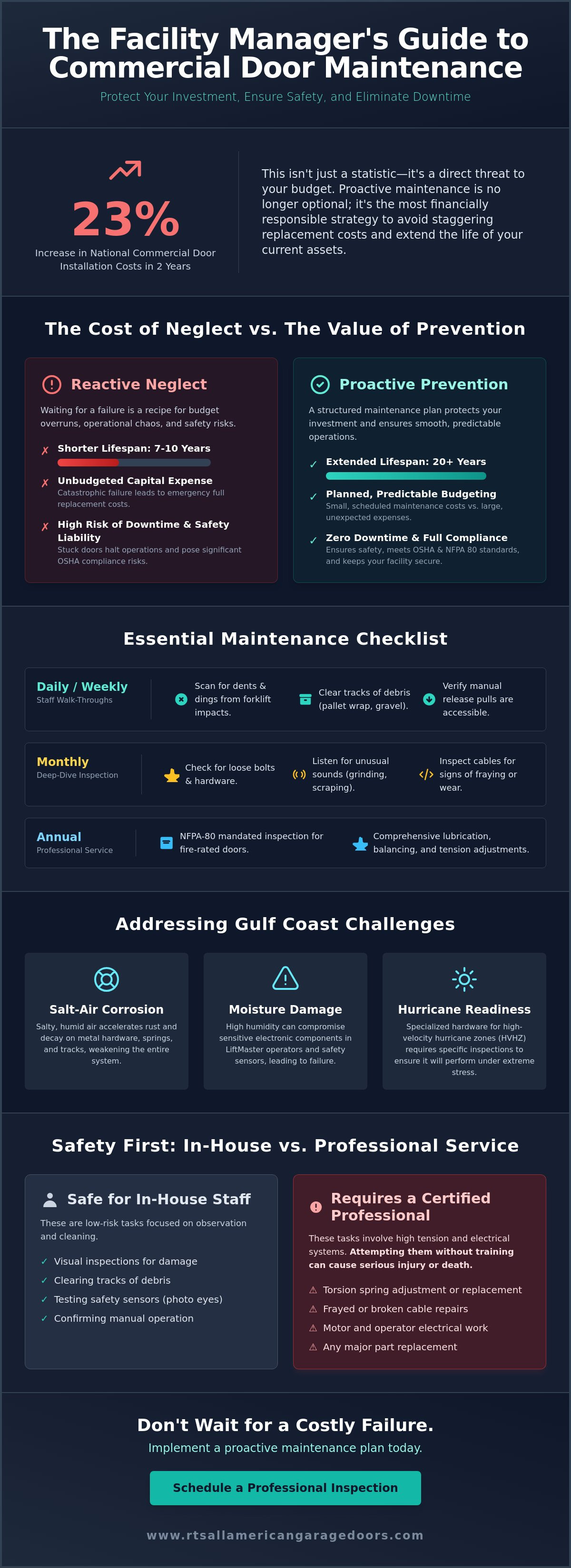
Did you know that national commercial door installation costs climbed by 23% over the last two years? For a Gulf Coast facility manager, that statistic isn't just a number; it's a direct threat to your annual budget. You already understand the frustration of a seized overhead door during peak hours or the constant worry that salt air is quietly corroding your hardware. Prioritizing commercial door maintenance is the only way to avoid these expensive headaches and ensure your facility remains safe and operational.
This guide provides a comprehensive, no-nonsense strategy designed to ensure safety, compliance, and zero operational downtime. You'll learn how to implement a predictable maintenance schedule that protects your investment and keeps your facility in line with 2026 ADA and NFPA 80 standards. We'll walk through a practical checklist covering everything from daily staff inspections to the specialized technical care required for high-velocity hurricane zone hardware. By the end, you'll have a clear roadmap to extend the life of your equipment and avoid those staggering emergency repair costs.
Key Takeaways
- Understand the financial difference between proactive prevention and the high cost of operational neglect in warehouse environments.
- Implement a structured daily and monthly checklist to identify frayed cables, loose bolts, or unusual mechanical sounds before they cause a failure.
- Protect your hardware from the unique threats of the Gulf Coast, including salt-air corrosion and moisture damage to electronic LiftMaster operators.
- Learn how to navigate the specific requirements for fire-rated and rolling steel doors to maintain safety and stay compliant with 2026 codes.
- Identify which commercial door maintenance tasks are safe for staff and which high-tension repairs require a professional to prevent serious injury.
Why Routine Commercial Door Maintenance is Mission-Critical for Your Business
Facility managers often view overhead doors as static fixtures, but they are actually complex mechanical systems that require constant attention. Effective commercial door maintenance is not a reactive "fix-it-when-it-breaks" task. Instead, it's a proactive system of scheduled inspections, precise lubrication, and hardware adjustments. When you treat your doors as critical infrastructure, you move away from the stress of emergency repairs and toward a predictable operational model. This disciplined approach ensures that every component, from the heavy-duty torsion springs to the smallest roller, functions exactly as intended.
The "Cost of Neglect" always outweighs the "Cost of Prevention" in a warehouse or industrial setting. A neglected door might only last seven to ten years before a catastrophic failure necessitates a full replacement. Conversely, with professional service and routine care, that same door can easily serve your facility for twenty years or more. Because national installation costs for new doors have increased by 23% over the last two years, extending the lifespan of your current equipment is the most financially responsible move you can make. It's the difference between a small, planned line item in your budget and a massive, unbudgeted capital expense.
The Financial Impact of Operational Downtime
Logistics and supply chain efficiency rely on movement, and that movement stops the moment a loading dock door seizes. For businesses operating near the Mobile ports or distribution hubs in Baldwin County, a single stuck door can halt an entire fleet of delivery trucks. This creates a bottleneck that ripples through your entire operation, leading to missed deadlines and frustrated clients. Beyond the logistics nightmare, a door that won't close properly is a significant security risk. It leaves your inventory exposed to theft and your facility vulnerable to the elements. You can't afford to leave your facility's perimeter compromised because of a preventable mechanical failure.
Safety and Regulatory Compliance (OSHA & NFPA)
Employee safety is your highest priority, and malfunctioning overhead doors are a primary source of workplace liability. OSHA requires employers to maintain a safe environment, which includes ensuring that all heavy machinery and doors are in good working order. Understanding Garage Door Safety and Mechanisms is vital for identifying potential hazards like frayed cables or failing sensors. Furthermore, NFPA-80 standards mandate that all fire-rated doors undergo a professional inspection at least once a year. Keeping meticulous maintenance records doesn't just keep you compliant with these codes; it provides a paper trail that protects your business during insurance audits or safety investigations. If an accident occurs, having proof of consistent commercial door maintenance can be your strongest defense.
The Essential Commercial Door Maintenance Checklist: Daily, Monthly, and Annual Tasks
A reliable commercial door maintenance program relies on consistency and a keen eye for detail. You don't need a degree in mechanical engineering to spot the early warning signs of a failure, but you do need a structured approach. By breaking tasks down into daily, monthly, and annual categories, you can catch minor issues before they escalate into expensive emergency repairs. This checklist serves as your facility’s first line of defense against operational downtime.
Daily and Weekly Staff Walk-Throughs
Your floor staff are your most valuable assets for early detection. Instruct them to perform a quick visual scan every morning. They should look specifically for "dents or dings" caused by forklift impacts, which can compromise the structural integrity of the panels. Even a minor bend in a track can cause the door to bind or jump during operation. Keep the tracks clear of pallet wrap, wood chips, or gravel, as debris is a leading cause of cable misalignment. Finally, verify that manual release pulls are accessible and functional. In an emergency or power failure, your team must be able to move the door manually without hesitation.
Monthly Deep-Dive Inspections
Once a month, take a closer look at the door’s mechanical health. Start with a balance test: disconnect the motor operator and lift the door halfway by hand. A properly balanced door should stay in place or move very slowly. If it slams shut or shoots upward, the spring tension is incorrect and requires professional adjustment. For more technical guidance on these procedures, consult an Overhead Door Maintenance Manual.
During this monthly check, inspect the following components:
- Hardware: Tighten any loose bolts on the hinges and track brackets.
- Cables: Look for "fuzzy" or frayed wires. If a cable looks worn, it's a safety hazard that needs immediate attention.
- Weather Seals: Check for cracks or gaps. A tight seal is essential for controlling humidity and cooling costs in Gulf Coast warehouses.
- Safety Sensors: Clean the photo-eye lenses with a soft cloth and ensure they are perfectly aligned.
Professional Annual Tune-Up Requirements
Some tasks are too dangerous for in-house staff. High-tension components like torsion springs and bottom brackets store immense energy and can cause severe injury if handled incorrectly. An annual professional tune-up ensures that your motor operator limits and force settings are calibrated to factory specifications. This prevents the motor from straining and extends the life of your equipment. If you encounter issues that go beyond basic lubrication, refer to our Warehouse Door Repair FAQ for expert troubleshooting. Staying ahead of these technical requirements is the best way to keep your facility running smoothly year-round without unexpected interruptions with the help of RTS All American Garage Doors.
Maintenance Requirements for Specialized Systems: Rolling Steel, Sectional, and Fire Doors
Different facilities require different hardware, and a one-size-fits-all approach to commercial door maintenance won't protect your investment. A sectional door in a distribution center faces different mechanical stresses than a rolling steel door in a high-security pharmacy. Understanding these distinctions allows you to tailor your inspections and address specific wear patterns before they cause a system failure. It's about knowing the unique "personality" of each door type in your facility.
Sectional vs. Rolling Steel: Different Wear Patterns
Sectional doors are the standard for most loading docks because of their insulation and ease of operation. However, because they use a track system that extends into the room, they're highly vulnerable to vehicle impacts. A slight bump from a forklift can bend a track or pop a roller out of place. For more detail on these specific vulnerabilities, see our guide on Loading Dock Door Repair. High-cycle environments also put extreme stress on hinges and rollers, which often need replacement every few years to keep the door moving smoothly.
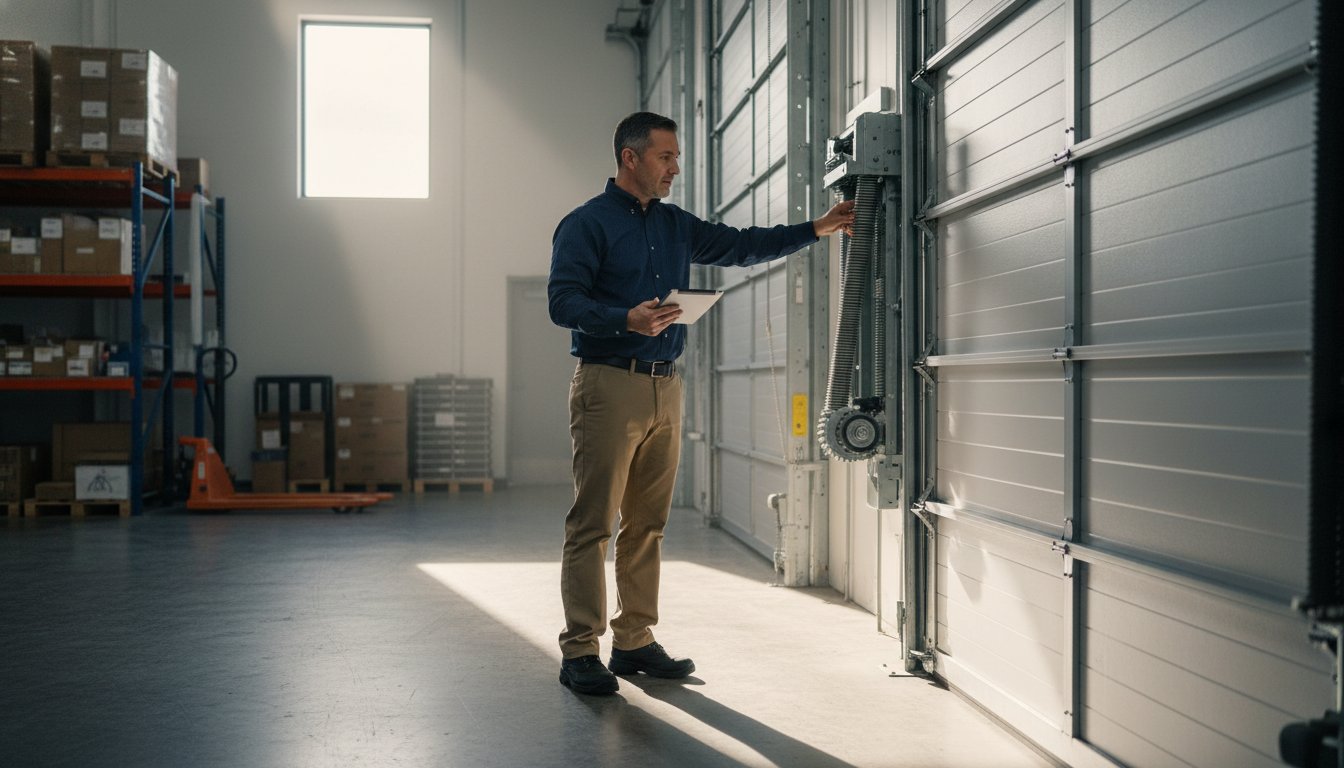
Rolling steel doors, while more compact and secure, have their own set of needs. They rely on a barrel assembly and a curtain that rolls up like a carpet. If the curtain becomes misaligned, it can jam inside the hood, leading to a dangerous and expensive repair. These systems require specialized internal spring lubrication to prevent metal-on-metal grinding. Following DASMA maintenance recommendations is the best way to ensure your rolling doors stay aligned and secure against unauthorized entry.
Fire Door Drop Testing and NFPA-80 Compliance
Fire doors are unique because they aren't just for operations; they're life-safety devices. NFPA-80 is the national standard that governs the installation and maintenance of fire-rated doors and shutters. Unlike standard doors, fire doors must undergo a mandatory "drop test" at least once a year. This test confirms that the door will close completely and latch automatically in the event of a fire, even if the building loses power.
This testing must be performed by a trained technician who can certify the results. During the test, we verify that the closing speed is safe and that the door isn't obstructed. You must keep the resulting documentation on-site to prove compliance to the fire marshal or your insurance auditor. If you don't have a record of these annual tests, you're not just risking a fine; you're creating a massive liability for your business. Proper commercial door maintenance for fire-rated systems isn't optional, it's a legal requirement that keeps your employees safe.
Addressing Gulf Coast Challenges: Salt Air, Humidity, and Hurricane Readiness
Operating a facility in places like Pensacola Beach or Gulf Breeze presents environmental challenges that managers in the Midwest never have to face. The beautiful coastal scenery comes with a price: a high-salt environment that is incredibly aggressive toward mechanical systems. Effective commercial door maintenance on the Gulf Coast must account for this constant chemical assault. If you don't adjust your care routine for the local climate, you'll find your hardware failing years before its time.
Our regional humidity is just as dangerous as the salt. High moisture levels can lead to condensation inside motor housings, causing moisture-related shorts in your LiftMaster commercial operators. Ensure that all electrical enclosures are properly sealed and that your staff checks for signs of corrosion on control boards during their weekly walk-throughs. Protecting these sensitive electronics is vital for maintaining the "zero downtime" promise of your facility.
Combating Hardware Corrosion in Coastal Alabama and Florida
Salt air is a silent killer for overhead doors. It causes pitting on door curtains and rapidly eats through standard steel components. For facilities located near the water, we always recommend upgrading to stainless steel or galvanized hardware to provide an extra layer of protection. A simple but effective maintenance trick is to regularly rinse salt residue off the door curtains with fresh water. This prevents the abrasive salt from grinding into the finish.
You should also pay close attention to your cables. In high-salt environments, they can corrode from the inside out, leading to sudden and dangerous snaps. Using "dry" silicone-based lubricants is also essential here. Traditional grease tends to attract sand and salt, which creates a grinding paste that destroys rollers and tracks. Switching to a dry formula keeps the moving parts slick without turning them into a magnet for coastal grit.
Pre-Season Hurricane Inspections for Commercial Doors
When storm season approaches, your doors are your facility's first line of defense against high winds. A "Hurricane Ready" door isn't just about the thickness of the panels; it's about the integrity of the entire system. During your pre-season check, verify the engagement of wind-locks on all rolling steel doors. These specialized clips keep the door curtain inside the tracks during extreme pressure.
You must also inspect the floor anchors and jamb attachments to ensure they haven't loosened or corroded over time. Finally, verify that your manual hoist operators are fully functional. If a storm knocks out power, your team needs a reliable way to secure the building or move equipment. If you haven't had a professional wind-load assessment recently, it's time to schedule a commercial door inspection to ensure your facility is truly prepared for the next big blow.
Professional Service vs. In-House Maintenance: When to Call RTS All American Garage Doors
Facility managers need to know exactly where upkeep ends and danger begins. Basic commercial door maintenance, such as cleaning tracks, wiping photo-eyes, and applying dry lubricant, is perfectly safe for your on-site team to handle. However, the moment a component needs to be unbolted, tensioned, or replaced, it becomes a professional repair task. Crossing that line without the right training puts your employees at risk and can lead to expensive equipment damage. It's about knowing when to step back for the safety of your crew.
At RTS All American Garage Doors, we've spent over 15 years serving the Gulf Coast as a family-owned business. We believe in total transparency, which is why we use a strictly defined, standardized pricing model. You won't find vague estimates or hidden surcharges when you work with us. We treat your facility with the same care we'd give our own, combining technical proficiency with the honest, neighborly values you expect from a local partner.
The Danger of High-Tension Component Repair
Commercial torsion springs are not just heavy pieces of metal. They are tightly wound energy sources that carry enough force to cause fatal injuries if they snap or if a winding bar slips during an adjustment. Unlike residential doors, commercial systems often use heavy-duty, high-cycle springs that require specialized tools to set the tension correctly. You shouldn't ever allow untrained staff to tinker with the spring assembly or the bottom brackets where the cables attach.
If your staff notices red flag symptoms, stop operation immediately and clear the area. These signs include frayed cables, a door that feels heavy when lifted manually, or a visible gap in a torsion spring coil. Attempting to fix these issues in-house is never worth the risk to human life. The technicians at RTS All American Garage Doors have the discipline and experience to handle these high-tension components safely, ensuring your door is perfectly balanced and secure.
Benefits of a Planned Maintenance Agreement
The best way to manage your facility budget is to eliminate the surprise of an expensive emergency failure. A Planned Maintenance Agreement with RTS All American Garage Doors turns reactive repairs into a predictable, scheduled line item. We visit your site at set intervals to perform deep-dive inspections and mechanical adjustments that go far beyond basic staff walk-throughs. This proactive commercial door maintenance is the most effective way to extend the lifespan of your equipment.
These scheduled visits allow us to catch wear on rollers, hinges, or tracks before they cause a total system shutdown. It also ensures your fire doors remain compliant with NFPA-80 standards through documented annual drop testing. With our commitment to labor transparency and traditional service values, you'll know exactly what to expect on every invoice. It's time to move from a state of uncertainty to a state of informed decision-making for your facility.
Schedule your commercial door maintenance with RTS All American Garage Doors today and ensure your operations stay on track.
Protect Your Operations with Proactive Facility Care
Effective facility management along the Gulf Coast requires a disciplined approach to equipment longevity. You've seen how routine inspections and environmental adjustments prevent salt air corrosion from turning a minor hardware issue into a major logistics failure. By prioritizing commercial door maintenance, you protect your budget from unpredictable repair costs and keep your team safe from the inherent dangers of high-tension mechanical systems. It's the difference between a facility that reacts to crises and one that runs with military precision.
RTS All American Garage Doors brings over 15 years of local industry experience to every job site. We don't believe in hidden fees or vague estimates. Our standardized pricing ensures you always know exactly what you're paying for before the work begins. When you call us, you speak with live, local technicians who understand the specific demands of Pensacola and Mobile area businesses. Don't wait for a breakdown to compromise your security or slow down your supply chain.
Get a Professional Commercial Door Maintenance Quote
We're ready to help you build a more resilient facility. Take the first step toward total operational peace of mind today.
Frequently Asked Questions
How often should commercial doors be serviced?
Most commercial doors should receive professional service at least every six months to maintain peak performance. If your facility operates in a high-cycle environment like a 24/7 distribution hub, you may require quarterly visits. Regular commercial door maintenance identifies wear on rollers and hinges before they cause a total system failure. This schedule ensures your hardware remains compliant with safety standards and operational needs.
Is annual fire door drop testing a legal requirement in Alabama and Florida?
Yes, annual fire door drop testing is a mandatory legal requirement under NFPA 80 standards in both Alabama and Florida. Local fire marshals require documented proof that your fire-rated doors will close and latch correctly during an emergency. Failing to provide this certification can lead to significant fines or liability issues for your business. A trained technician must perform the test to ensure the system meets all federal and state safety codes.
What are the signs that my commercial door springs are failing?
You can identify failing springs by looking for visible gaps in the torsion coils or noticing if the door feels unusually heavy when operated manually. If you hear loud bangs or grinding sounds during a cycle, the springs may be reaching the end of their lifespan. Because these components are under extreme tension, you should never attempt to adjust them yourself. Contact a professional to inspect the balance and tension of your system immediately.
Can my in-house maintenance team perform commercial door repairs?
Your in-house team can handle basic commercial door maintenance like cleaning tracks or lubricating hinges, but they should not perform technical repairs. Replacing torsion springs, cables, or bottom brackets involves high-tension components that can cause fatal injuries if handled incorrectly. Specialized tools and training are required to wind springs and align tracks to factory specifications. It's safer and more cost-effective to leave complex mechanical repairs to experienced technicians.
What is the difference between a sectional door and a rolling steel door?
Sectional doors consist of horizontal panels that travel along tracks and rest parallel to the ceiling when open. They are popular for their insulation and aesthetic options. Rolling steel doors are made of interlocking slats that roll into a compact coil above the door opening. While rolling doors are often preferred for high-security applications, sectional doors are common in loading docks where space is available for overhead tracks.
How does salt air affect commercial garage door hardware?
Salt air accelerates the oxidation process, leading to rapid corrosion and pitting on steel hardware and cables. In coastal areas like Pensacola Beach, this environment can cause standard metal components to seize or snap much faster than in inland facilities. You must use galvanized or stainless steel hardware and perform frequent fresh-water rinses to protect your investment. Using dry silicone lubricants also helps prevent salt and sand from building up in moving parts.
What should I do if my commercial door is hit by a forklift?
You should stop operation of the door immediately and clear the area to prevent injury or further mechanical damage. Even a minor impact can bend a track or dislodge a roller, which could cause the door to fall or bind during its next cycle. Inspect the panels for structural compromise and check the alignment of the tracks. A professional technician should verify that the safety sensors and cables are still functioning correctly before returning the door to service.
Does RTS All American provide 24/7 emergency commercial repair?
You can determine our current service availability by calling our office to speak with a live, local representative. We understand that door failures cause significant operational stress, so we focus on providing efficient scheduling and transparent pricing for all our Gulf Coast partners. Our team is committed to delivering professional service that minimizes your downtime while maintaining the highest safety standards for your facility. We don't use hidden surcharges or vague estimates for our work.