A single stuck door can cost your Mobile or Pensacola facility an average of $1,700 per hour in lost productivity. In our high-salt Gulf Coast environment, loading dock door repair is a constant race against corrosion that threatens to seize your operations without warning. You already know that an offline bay creates a bottleneck that ripples through your entire supply chain. Beyond the delays, a malfunctioning door invites the sweltering Alabama heat inside, driving up energy costs and creating safety hazards that could lead to OSHA fines as high as $16,550 for a single serious violation.
We understand that you need your facility to run like a well-oiled machine, and we're here to help you maintain that standard of excellence. This guide shows you how to identify early warning signs, troubleshoot common mechanical failures, and resolve issues before they compromise your facility's security. We'll provide a clear look at the differences between repairing specific components and investing in a full replacement. By the end of this article, you'll have the technical knowledge needed to keep your warehouse running at peak efficiency while avoiding the high costs of unexpected downtime.
Key Takeaways
- Identify the high-tension mechanical components, such as torsion springs and rollers, that most frequently cause operational bottlenecks in high-traffic environments.
- Learn to calculate the "nuisance cost" of repetitive service calls to decide when loading dock door repair is no longer the best financial move for your facility.
- Establish a proactive lubrication and inspection schedule to combat the corrosive effects of Gulf Coast humidity on your door's hardware.
- Understand your liability under current OSHA safety standards and how to maintain a hazard-free workplace through regular equipment checks.
- Discover why local response times and knowledge of regional building codes in Mobile and Baldwin County are critical for minimizing shipping delays.
What is Loading Dock Door Repair and Why is it Critical?
Loading dock door repair is the specialized technical service of restoring full mechanical functionality to commercial sectional or roll-up doors at shipping and distribution hubs. Unlike a standard garage door, a commercial dock door is a high-cycle component that must withstand constant movement and heavy industrial use. A loading dock serves as the primary point of entry for your inventory, making its operational status vital to your bottom line. When a door malfunctions, it isn't just a maintenance headache; it's a complete stop to your facility's workflow.
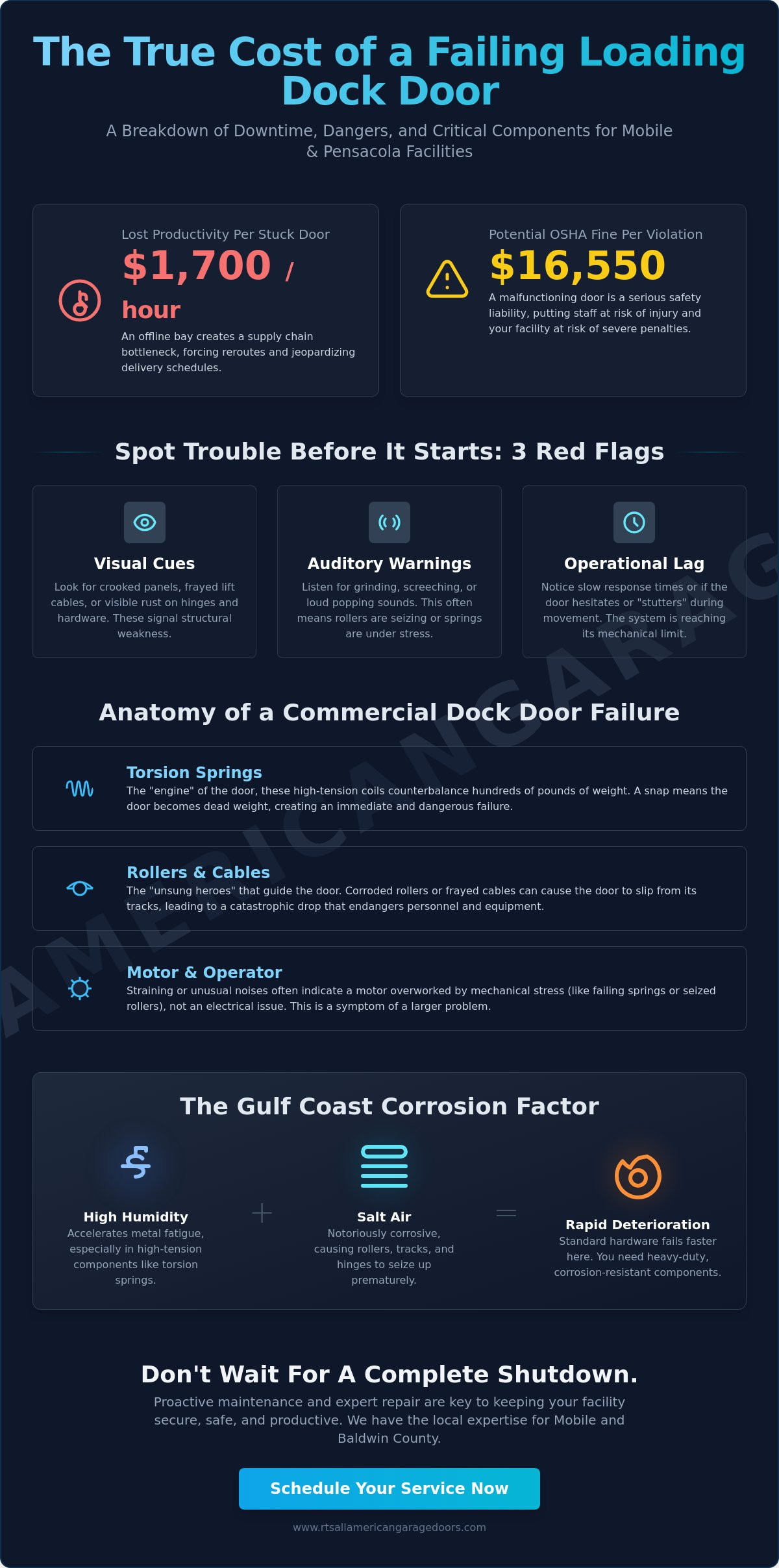
The cost of a "dead" dock is staggering. Industry data suggests that an offline loading dock can cost a facility an average of $1,700 per hour in lost productivity. This bottleneck forces your logistics team to reroute shipments to other bays, causing delays that frustrate drivers and jeopardize delivery schedules. Beyond the financial impact, safety is the most urgent concern. A malfunctioning door is a massive liability. If a door falls unexpectedly or fails to seal properly, it puts forklift operators and warehouse staff at risk. As of 2026, OSHA penalties for serious violations related to dock safety can reach $16,550 per violation, making proactive loading dock door repair a financial and legal necessity.
Security is the final piece of the puzzle. A door that won't close fully or has damaged panels is an open invitation for intruders. It also fails to protect your inventory from the intense Alabama elements. In a climate where humidity and heat are constant, a broken seal or a stuck door allows conditioned air to escape. This leads to high energy loss and potential damage to climate-sensitive goods stored near the bay.
Common Signs Your Dock Door Needs Immediate Service
You don't always have to wait for a total failure to know something is wrong. Catching these issues early can prevent a total operational seizure. Watch for these red flags:
- Visual cues: Look for crooked panels, frayed lift cables, or rusted hinges. These indicate structural weakness that could lead to a sudden drop.
- Auditory warnings: Listen for grinding, screeching, or excessive vibration. These sounds often mean your rollers are seizing or the motor is straining against a misalignment.
- Operational lag: If you notice slow response times or "dead spots" where the door hesitates during its travel, the system is likely reaching its mechanical limit.
The Impact of Local Climate on Dock Hardware
The Gulf Coast presents unique challenges for industrial hardware that inland facilities don't face. High humidity levels accelerate metal fatigue, particularly in high-tension commercial springs. Salt air near Mobile and Pensacola is notoriously corrosive; it can seize up rollers and track assemblies much faster than expected. Standard residential solutions simply don't have the durability to survive these conditions. Commercial doors require heavy-duty components designed to resist corrosion and handle the repetitive stress of a busy shipping hub.
The Anatomy of a Commercial Dock Door Failure
Commercial dock doors are heavy pieces of industrial machinery. They rely on a precise balance of tension and alignment to function safely. While they might look like larger versions of residential doors, the stresses they endure are significantly higher. Understanding the mechanical components is the first step in knowing when you need professional loading dock door repair before a minor glitch turns into a total bay shutdown. Every part of the system has a finite lifespan, and in the Gulf Coast, that lifespan is often shortened by environmental factors.
The torsion spring is the engine of your door. These high-tension coils do the heavy lifting, counterbalancing the weight of massive steel panels so the motor can move them easily. When a spring snaps, the door becomes dead weight, often weighing several hundred pounds. This puts immense strain on the cables and rollers. These "unsung heroes" are responsible for keeping the door in the tracks. If a cable frays or a roller seizes due to salt air corrosion, the door can slip, leading to a catastrophic drop. Following industry standards for commercial doors is the best way to ensure these components are rated for the high-cycle demands of a busy warehouse.
Motor and operator issues often present as electrical failures, but they are frequently symptoms of mechanical stress. If your LiftMaster operator is straining or making unusual noises, it's often fighting against a door that is out of balance. Identifying whether the issue is a burnt-out circuit or a mechanical obstruction is critical. If you notice your door hesitating or moving unevenly, scheduling a professional inspection with RTS All American Garage Doors can help diagnose the root cause before the motor burns out entirely.
Spring and Cable Fatigue in High-Traffic Bays
Commercial springs are typically rated for 10,000 to 100,000 cycles. In a high-traffic Mobile facility, you might hit those numbers faster than you think. Cables often show signs of fatigue through "birdcaging" or visible fraying. Never attempt to adjust these yourself. The tension in a commercial spring is high enough to cause severe injury. Professional technicians use specialized tools to wind these springs to the exact specifications required for safe operation.
Track Realignment and Panel Damage
Forklift impacts are the leading cause of track warping in Baldwin County facilities. Even a minor bump can knock a track out of vertical alignment, causing the door to bind. Additionally, the shifting coastal soil can cause foundations to settle, slowly pulling tracks out of square. If a panel is dented, you don't always need a new door. We can often perform a garage door panel replacement for specific sections. Keeping your panels and weather seals intact is vital for preventing HVAC leakage during the peak of the Alabama heat.
Repair vs. Replacement: Making the ROI Decision
Deciding whether to authorize a loading dock door repair or invest in a full replacement is a critical ROI calculation for any facility manager. You have to weigh the immediate cost of the fix against the long-term operational savings of new, more efficient equipment. While a high-quality commercial door typically has a service life of 15 to 20 years, high-volume bays in the Gulf Coast often reach their mechanical limit sooner due to the relentless humidity and heavy use. If your door is less than a decade old and only suffers from a single component failure, a targeted repair is usually the most sensible path for your budget.
You should calculate your "nuisance cost" when making this choice. This is the sum of repetitive service calls, lost productivity during downtime, and emergency fees. If you're calling a technician three or four times a year for the same bay, the cumulative expense often exceeds the cost of a new installation. At RTS All American Garage Doors, we believe in total transparency. We use standardized pricing models so you know exactly what you're paying for. This eliminates the ambiguity of hidden surcharges and helps you make an informed decision based on hard numbers rather than guesswork.
Energy efficiency is another factor that pays dividends over time. Old, uninsulated doors act as thermal bridges; they allow the Alabama heat to overwhelm your HVAC system. Modern Wayne Dalton insulated steel doors offer superior R-values that significantly reduce monthly cooling bills. When a door no longer seals tightly against the elements, the "repair" might just be a temporary patch on a much larger financial leak.
When to Opt for Professional Repair
Repair is the right choice for isolated hardware failures that don't compromise the door's structural integrity. If you have a single broken torsion spring, a snapped cable, or worn rollers, these are routine fixes that restore full function. Minor track misalignments caused by light impacts are also easily corrected by a professional team. As long as the door is less than 10 years old and the core panels remain straight and solid, a professional repair protects your bottom line while keeping your facility secure.
When Replacement is the Smarter Move
Replacement becomes the smarter move when you face severe structural damage to multiple panels or the main frame. Buckled steel cannot be easily hammered back into a safe operating state. You should also consider a new system if your motor parts are obsolete. Trying to source components for a discontinued operator leads to extended downtime that your logistics chain cannot afford. Finally, upgrading to a hurricane proof garage door installation is a strategic necessity for Gulf Coast facilities. Higher wind-load ratings ensure your warehouse remains protected and compliant with local building codes during storm season.
Maintenance and Safety: Meeting OSHA Standards
Safety at your shipping hub isn't just a matter of operational preference; it's a legal mandate. Loading docks are high-risk zones that account for 25% of all warehouse accidents. If a door fails and causes an injury, your facility faces significant liability. As of January 2026, the maximum OSHA fine for a serious violation is $16,550. If the violation is deemed willful or repeated, that penalty jumps to $165,514. Investing in proactive loading dock door repair and regular upkeep is the most effective way to shield your business from these crushing costs and keep your workers safe.
Humidity is the silent enemy of your door's mechanical integrity. In the Gulf Coast climate, hardware can seize up in months if left untreated. You should establish a strict lubrication schedule using industrial-grade lithium or silicone sprays. Avoid heavy grease, which attracts the grit and dust common in warehouse environments. Additionally, your team must test the auto-reverse feature on your LiftMaster operators monthly. A door that doesn't stop and reverse when it hits an obstruction is a crushing hazard that can lead to a "failure to abate" fine of $16,550 per day.
We recommend a five-minute daily visual inspection for your floor team. Train your staff to look for gaps in weather seals, loose hardware, or any hesitation in the door's travel. These small observations often catch a problem before it requires an emergency service call.
The Commercial Maintenance Checklist
Heavy-duty use creates constant vibration that naturally loosens the components of your door system. Your maintenance team should focus on these three areas:
- Tighten hardware: Check every hinge, bolt, and bracket. A single loose fastener can cause a panel to shift, leading to a track jam.
- Verify balance: Disconnect the opener and lift the door halfway by hand. If it doesn't stay in place, your torsion springs are fatigued and require professional adjustment.
- Clear the tracks: Sweep out debris and metal shavings. Obstructions in the track lead to flat spots on your rollers, which eventually causes the door to seize.
Professional Inspections and Documentation
While daily checks are vital, they don't replace a professional safety audit. Having a documented paper trail of professional service protects your business during an OSHA inspection or an insurance claim. A certified technician looks beyond the surface to inspect internal motor gears and spring tension levels that aren't visible to the naked eye. For specific equipment questions or troubleshooting tips, you can refer to our warehouse door repair guide. If you're ready to secure your facility, contact RTS All American Garage Doors to schedule a comprehensive maintenance visit today.
Why Local Expertise Matters for Your Loading Dock
When your facility's workflow depends on a single bay, you can't afford to wait for a technician traveling from several states away. National providers often have impressive digital footprints, but their response times rarely match the urgency of a Gulf Coast logistics manager. In a region where shipping schedules are tight and weather is unpredictable, local expertise is the difference between a minor delay and a total operational shutdown. Choosing a partner for loading dock door repair who lives and works in your community ensures that your facility remains a priority rather than just another ticket in a queue.
Local knowledge also extends to the specific building codes and wind-load requirements of Baldwin County and the City of Mobile. We understand the technical nuances required to keep your commercial overhead doors compliant with regional safety standards. Beyond compliance, there is the issue of financial integrity. Many competitors use the "commercial" label as an excuse for vague estimates and hidden surcharges. RTS All American Garage Doors operates on a foundation of transparency. Our standardized pricing structure acts as a verbal handshake; you'll always know the cost of labor and parts before the work begins.
Our technicians are highly trained professionals who treat every industrial system with the care it deserves. We don't just patch the problem. We look at the mechanical health of the entire system to prevent future failures. This disciplined approach to service is what distinguishes a local expert from a faceless corporation.
Serving Mobile, Pensacola, and Beyond
For over 15 years, we've served as a reliable partner for facilities throughout Baldwin County and the surrounding coastal communities. As a family-owned business, we take immense pride in our reputation within the Gulf Coast. We understand that your loading docks are critical shipping infrastructure. When you call RTS All American Garage Doors for an emergency repair, you're speaking to neighbors who value punctuality, honesty, and thoroughness. We've built our business on these traditional service values, ensuring that your warehouse stays secure and your shipments stay on schedule.
Get Your Facility Back on Track
Scheduling a service call shouldn't be a complicated process. When you reach out to RTS All American Garage Doors, you won't get stuck in a loop of automated menus or offshore call centers. You'll talk to real local pros who can dispatch help quickly. During your first service call, our technician will perform a detailed diagnostic check, explain the necessary repairs in straightforward language, and provide a clear path to restoration. Don't let a broken door compromise your facility's security or efficiency. Contact RTS All American Garage Doors for expert loading dock door repair today.
Secure Your Shipping Hub with Proactive Service
Transitioning from reactive fixes to a proactive maintenance strategy is the most effective way to protect your bottom line. By understanding the mechanical stresses on your springs and the regulatory weight of safety standards, you can keep your bay doors operational and your staff protected. A reliable facility starts with equipment you can trust to perform under the heavy demands of the shipping industry. Maintaining this standard requires a partner who understands that every minute of downtime is a minute of lost revenue.
Our team brings 15+ years of local experience to every facility we visit across Mobile and Pensacola. We provide live, local technicians who understand the specific challenges of the Gulf Coast climate and the importance of punctuality. Because we value transparency, we always provide standardized pricing with no hidden fees. Choosing a partner for loading dock door repair shouldn't be a gamble on quality or cost; it should be a professional handshake you can count on.
Schedule Your Commercial Dock Door Inspection with RTS All American Garage Doors to ensure your facility remains a leader in efficiency. We're here to help you keep your business moving forward with the integrity and technical skill your operations deserve.
Frequently Asked Questions
How quickly can you respond to a loading dock door emergency in Mobile?
Our local technicians prioritize service calls within Mobile and Baldwin County to get your shipping bays back in service as quickly as possible. We understand that an offline dock can cost a facility an average of $1,700 per hour in lost productivity. By keeping our team local, we avoid the long travel delays and scheduling hurdles often associated with national service providers.
What are the most common causes of loading dock door failure in coastal areas?
Salt air corrosion and high humidity are the primary culprits for hardware failure in Gulf Coast facilities. These environmental factors accelerate metal fatigue in torsion springs and cause rollers to seize within the tracks. Regular loading dock door repair and proactive lubrication are essential strategies for preventing premature system failure caused by our unique coastal climate.
Can you repair commercial doors from manufacturers like Wayne Dalton and others?
Yes, we specialize in repairing commercial overhead doors from major manufacturers, including the Wayne Dalton Classic Steel and Carriage House series. Our technicians are also trained to service LiftMaster belt, chain, and wall mount openers. We maintain a stock of high-quality replacement parts to ensure your specific door model is restored to professional operational standards.
Is it cheaper to repair a single panel or replace the entire sectional door?
It's generally more cost-effective to perform a garage door panel replacement if the damage is isolated to one or two sections. If the main frame remains square and the remaining panels are structurally sound, swapping specific parts saves you the expense of a full installation. We'll always provide an honest assessment if the door's overall integrity is compromised beyond a simple fix.
How often should my warehouse doors be professionally inspected for safety?
You should schedule a professional safety inspection at least once every six to twelve months, depending on your facility's traffic volume. High-cycle bays in busy distribution hubs require more frequent checks to ensure torsion springs and cables meet current safety requirements. These regular audits help you stay compliant with OSHA standards and prevent unexpected operational shutdowns during peak shipping seasons.
What happens if my dock door is hit by a forklift—is it always a total loss?
A forklift impact isn't always a total loss; many doors can be saved through professional track realignment and panel replacement. We can often straighten warped tracks or replace the bottom section if the impact was minor and didn't twist the main frame. Our goal is to provide a functional repair that restores facility security without forcing an unnecessary full-door replacement.
Do you offer standardized pricing for commercial door spring replacements?
We utilize a strictly defined, standardized pricing structure for all loading dock door repair services, including spring and cable replacements. This transparency serves as a verbal handshake with our customers, ensuring you never face hidden surcharges or vague estimates. You'll receive clear labor and parts costs before any work begins on your facility's commercial systems.
How do hurricane-rated dock doors differ from standard commercial doors?
Hurricane-rated doors feature reinforced internal struts, heavier-gauge steel, and specialized hardware designed to withstand extreme wind-load pressures. Unlike standard commercial doors, these systems are engineered to meet specific building codes in coastal areas like Mobile and Pensacola. Upgrading to these systems provides a critical layer of protection for your inventory and structural integrity during severe Gulf Coast storms.