A malfunctioning bay door isn't just a mechanical nuisance; it's a direct threat to your daily revenue and employee safety. You've likely felt the frustration of a stalled shipment or a security risk because a high-cycle door failed at the worst possible moment. When your facility depends on moving goods in and out, getting a professional commercial overhead door repair shouldn't be a source of stress. It should be a straightforward process that restores your workflow without hidden fees or technical jargon.
We know that unpredictable repair costs and salt-air corrosion on hardware can make managing a Gulf Coast facility feel like an uphill battle. This guide will teach you how to diagnose common failures, navigate safety requirements like the OSHA General Duty Clause, and protect your bottom line. We'll walk through the essential steps to restore function quickly and establish a maintenance routine that ensures your Wayne Dalton doors and LiftMaster openers remain reliable. You'll learn exactly what it takes to keep your operations moving and your team safe in any environment.
Key Takeaways
- Identify the root causes of mechanical failure, from high-cycle fatigue to forklift impacts, so you can stop problems before they stall your operations.
- Learn how to manage a commercial overhead door repair safely by securing the area and evaluating critical components like industrial-grade lift cables.
- Apply the "Rule of 50" to decide whether a quick panel replacement or a full system upgrade makes the most sense for your facility's budget.
- Understand the importance of standardized pricing and local Gulf Coast expertise when choosing a partner to maintain your Wayne Dalton or LiftMaster systems.
- Follow a structured response plan for door emergencies to protect your employees and maintain compliance with workplace safety standards.
Understanding Commercial Overhead Door Repair and Failure
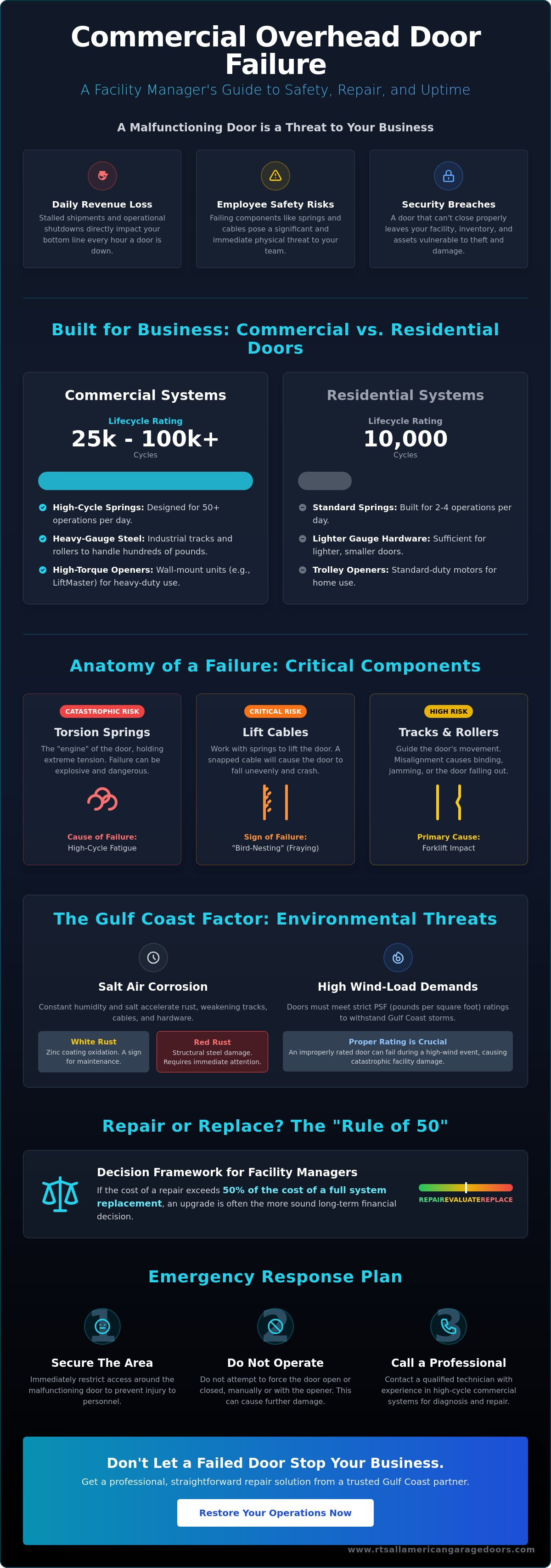
Commercial overhead door repair is a specialized service designed for high-cycle, heavy-duty industrial systems. Unlike a home garage, an industrial bay door might operate fifty times a day or more. This constant motion leads to high-cycle fatigue, where metal components simply wear out from repetitive stress. Beyond natural wear, forklift impacts and a lack of routine lubrication are the most common reasons these systems fail. When your facility depends on moving goods, commercial overhead door repair becomes a priority for maintaining both safety and speed. A broken loading dock door stops the supply chain. It's more than a mechanical issue; it's an operational shutdown that costs your business money every hour the door stays shut.
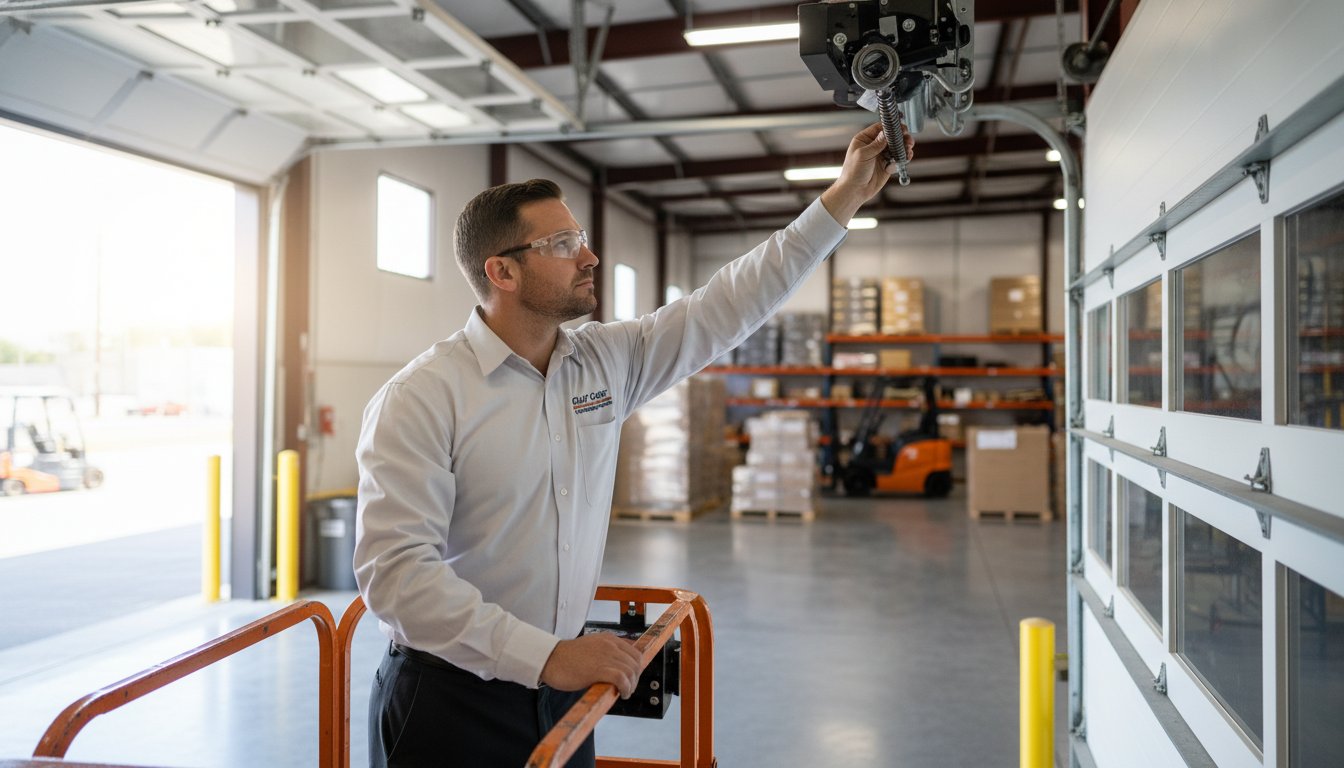
Safety is the most critical factor during any repair. The Garage door components in a commercial setting, particularly the torsion springs, hold significantly more energy than residential models. These springs are the engine of the door. They're wound under extreme tension to lift panels that can weigh hundreds of pounds. If they snap or are handled without professional tools, the release of force can be catastrophic. Because of these risks, industrial systems require a higher level of technical expertise to ensure the door remains balanced and the safety sensors function correctly.
Commercial vs. Residential Repair: Key Differences
The mechanical requirements for a business are much higher than for a home. Residential springs typically handle 10,000 cycles, but commercial systems require ratings between 25,000 and 100,000 cycles to withstand daily use. Industrial tracks and rollers also use heavier gauge steel to prevent bending under the weight of oversized panels. To move these heavy systems, businesses rely on high-intensity openers, such as LiftMaster wall-mount units. These openers provide the torque needed for tall ceilings and heavy-duty operation without the footprint of a traditional trolley system. They also offer advanced logic boards that can handle the complex safety needs of a busy warehouse.
The Impact of the Gulf Coast Climate
Operating a facility in Pensacola Beach or Mobile presents unique challenges. Salt air is a constant threat that accelerates corrosion on commercial tracks and cables. You'll often see "white rust," which is the oxidation of the protective zinc coating, but "red rust" is a sign of deep structural damage that requires immediate attention. Additionally, commercial doors in our region must meet strict wind-load requirements. We evaluate the PSF (pounds per square foot) ratings of your system to ensure it can withstand the pressure changes common during Gulf Coast storms. A door that isn't properly rated or maintained can fail during a high-wind event, leading to significant property damage and safety hazards for your staff.
Common Commercial Door Components and Failure Points
Every industrial door is a complex machine that relies on a handful of heavy-duty parts to function. When one component fails, the entire system becomes a liability. Understanding these parts helps you identify when a professional commercial overhead door repair is necessary before a minor glitch turns into a total facility shutdown. Most failures aren't random; they're the result of high-cycle wear or environmental stress that eventually pushes hardware past its limit.
Spring and Cable Mechanics
The torsion springs are the engine of your door system. They do the heavy lifting, but they're under incredible torque. Don't ever attempt a "DIY" fix on commercial springs. The tension required to lift an industrial door can cause severe injury if a winding bar slips or a bracket breaks. We use high-cycle replacement springs at RTS All American Garage Doors because they're built to last twice as long as standard parts. This longevity is vital for businesses that cycle their doors dozens of times a day.
Cables work in tandem with those springs. You should regularly inspect your lift cables for "bird-nesting," which is when individual steel strands begin to fray and unravel. This is a critical emergency. If one cable snaps, the door will crash down unevenly, likely bending the tracks and destroying the rollers. Spotting these signs of cable fatigue early saves you from the much higher cost of a full door rebuild.
Tracks, Rollers, and Hinges
In a busy warehouse, forklift impact is the leading cause of track misalignment. Even a small bump can knock a vertical lift track out of plumb, causing the door to bind or even fall out of the opening. If your tracks are bent, the door won't seal properly, which ruins your climate control. We also pay close attention to the gauge of your hardware. Commercial doors should use 11-gauge or 14-gauge steel hinges. Lighter residential hinges simply can't handle the shearing force of a heavy industrial panel.
Your choice of rollers also matters. In high-moisture environments like Baldwin County, we often recommend nylon rollers with sealed bearings. While steel rollers are traditional, they're prone to rust when exposed to our salty Gulf Coast air. Nylon resists corrosion and offers a quieter, smoother operation. Keeping your commercial overhead doors properly equipped with the right hardware for our climate is the best way to ensure long-term reliability.
Finally, your openers and safety sensors must remain in top shape to stay compliant with OSHA workplace safety rules. Following industry safety standards isn't just a legal requirement; it's a moral one. If a photo-eye sensor is misaligned or a secondary sensing edge fails, you risk a workplace accident that could have been easily avoided with a routine inspection.
Repair vs. Replace: A Decision Framework for Facility Managers
Deciding between a patch-up and a total system overhaul is one of the toughest calls for a facility manager. You don't want to waste company capital on a door that's past its prime, but you also can't justify a full replacement if a simple commercial overhead door repair will do the trick. We recommend using the "Rule of 50" as your guide. If the cost of the repair exceeds 50% of the door’s total replacement value, it’s usually time to invest in a new system. This framework prevents you from throwing good money after bad on hardware that has reached the end of its service life.
Panel damage is a common gray area. If a forklift dings a single section of your Wayne Dalton door, you don't necessarily need a whole new unit. We can often perform a garage door panel replacement for specific models, provided the tracks and hinges aren't compromised. However, if multiple panels are sagging or bowing from structural fatigue, the integrity of the door is gone. Continuing to operate a compromised door could violate OSHA's General Duty Clause, which requires employers to maintain a workplace free from recognized hazards. A bowing door is a recognized hazard that threatens your team's safety.
When to Choose Repair
Repair is the logical choice when the issue is isolated to consumable parts. If your door is relatively new but a spring has snapped or a cable has frayed, a targeted commercial overhead door repair is the most cost-effective path. We look for specific signs that the system still has plenty of life left. Common scenarios include:
- Isolated hardware failure: Replacing a single torsion spring or a set of cables on a door less than ten years old.
- Minor track issues: Realigning a vertical track that was bumped but not structurally crushed.
- Electronic glitches: Swapping out a LiftMaster logic board or realigning photo-eye sensors to restore function.
- Roller wear: Trading out noisy, vibrating steel rollers for smooth, sealed-bearing nylon versions.
When Replacement is the Smarter Investment
Sometimes, the age of the door makes a fix impossible. If you’re dealing with an orphan brand where parts are no longer manufactured, you’re looking at a full replacement. In Gulf Breeze and surrounding coastal areas, upgrading to a hurricane-rated model offers long-term ROI through insurance premium credits. It's often smarter to replace if you face:
- Structural fatigue: The door sections are visibly sagging or "smiling" when in the open position.
- Energy loss: Your old uninsulated doors are driving up cooling costs in the summer heat.
- Code compliance: Bringing your facility up to date with hurricane proof garage door installation standards.
- Frequency of failure: When the cost of three service calls in a year equals a significant portion of a new door's price.
How to Manage a Commercial Door Emergency: A Step-by-Step Response
When a bay door stops moving, your first priority is safety, followed immediately by getting a professional commercial overhead door repair to minimize downtime. A broken door creates a bottleneck that ripple-effects through your entire logistics chain. Don't let a mechanical failure turn into a workplace injury. Follow this structured response to keep your team safe and your facility secure while you wait for a technician to arrive.
Step 1: Secure the area. Establish a safety perimeter at least ten feet away from the door. Use caution tape or traffic cones to create a "No-Go" zone. If a torsion spring has snapped, the door could shift or drop unexpectedly. Step 2: Check the door's position. Only disconnect the motorized opener if the door is in the fully closed position. Disconnecting a door that is stuck halfway up can cause it to crash down with thousands of pounds of force. Step 3: Perform a visual inspection. Look for obvious signs of trouble like frayed cables, gaps in the coils of a torsion spring, or bent tracks. Do not touch any moving parts or high-tension brackets. Step 4: Contact a local specialist. Reach out to RTS All American Garage Doors to ensure you receive standardized pricing. This ensures you won't be hit with "emergency surcharges" or hidden fees just because you're in a tough spot. Step 5: Document the damage. Take clear photos of the failure point and any impact damage. These records are vital for insurance claims or internal maintenance logs.
Immediate Safety Protocols
Safety isn't just a suggestion; it's a requirement. If you suspect a broken spring, treat the door like a loaded weapon. Never attempt to "help" a motorized opener lift a struggling door. This puts extreme stress on the LiftMaster gear kit and can lead to a total motor burnout. We also recommend following standard lock-out/tag-out procedures. Cut the power to the opener and tag the wall station so no one accidentally tries to operate the door while it's compromised. Manual operation is a last resort. If the door feels heavy or makes a grinding sound, stop immediately. Forcing it will only lead to more expensive track and roller damage.
Working with Professional Technicians
To get your business back online quickly, have your information ready before you call. Note the approximate door size and the brand, such as Wayne Dalton. If you're dealing with specific model issues, reviewing a Wayne Dalton garage door repair Pensacola checklist can help you describe the symptoms more accurately to the dispatcher. This helps the technician arrive with the right high-cycle springs or heavy-duty cables on the truck. Always verify that your service partner is fully insured to work on industrial sites. When you're ready to restore your facility's security, you can schedule your commercial overhead door repair with a team that values transparency and traditional service values.
Why RTS All American Garage Doors is the Trusted Partner for Gulf Coast Businesses
Choosing a partner for your facility's maintenance shouldn't be a gamble. RTS All American Garage Doors understands that local business owners need more than just a repairman; they need a reliable asset. We've built our reputation on the Gulf Coast by offering live, local dispatch. When you call us, you aren't routed to a national call center in another time zone. You speak with a technician who knows the specific challenges of operating a warehouse in Mobile or a retail space in Pensacola. This local connection ensures that your commercial overhead door repair is handled with speed and accuracy, keeping your operations on schedule.
Our team focuses specifically on Wayne Dalton and LiftMaster commercial systems. This isn't by accident. These brands provide the durability required for high-cycle industrial use. Because we're authorized dealers, our trucks are stocked with OEM parts that meet the exact specifications of your system. We don't use "universal" parts that might fail under the high-torque demands of a vertical lift door. This specialization allows us to provide a high level of technical proficiency that general contractors simply can't match. We know these systems inside and out, which means we spend less time diagnosing and more time fixing.
Our Commitment to Integrity
Integrity is the foundation of our business. We don't believe in "commercial surcharges" or hidden fees that inflate your bill during an emergency. RTS All American Garage Doors uses standardized pricing to ensure every customer receives the same honest rate. This disciplined approach comes from our background in military and first responder service. We value punctuality and thoroughness because we know your business can't wait. We also emphasize prevention to help you avoid future headaches. Investing in a garage door tune-up service Mobile AL is a smart way to catch hardware fatigue or track misalignment before it leads to a total system failure.
Serving Mobile, Pensacola, and Baldwin County
We serve the entire region, from the industrial docks of Mobile to the busy distribution centers of Baldwin County. Our technicians are experts in coastal-specific hardware and local wind-load compliance. We understand that a door in Gulf Breeze needs to be more than just functional; it has to be storm-ready. RTS All American Garage Doors offers customized maintenance plans that go beyond simple fixes. We look at the long-term health of your commercial investment, providing the specialized care needed to survive our humid, salty environment. When you partner with us, you're choosing a team that treats your facility with the same respect and care we give our own. We get the job done right the first time so you can get back to work.
Secure Your Facility's Future with Professional Maintenance
Managing a commercial facility requires constant attention to detail, especially regarding the heavy-duty systems that keep your goods moving. By understanding the mechanics of high-cycle springs and applying the "Rule of 50" to your hardware, you can make informed decisions that protect your bottom line. Whether you're dealing with a sudden cable snap or planning long-term hurricane resilience, a proactive approach to commercial overhead door repair is the best way to prevent costly operational downtime. Professional oversight ensures your team stays safe and your workflow remains uninterrupted.
RTS All American is here to serve as your dependable local partner. As a family-owned and operated business, we prioritize integrity and transparency in every job we take. We are an authorized Wayne Dalton and LiftMaster dealer, ensuring your system receives the specialized care it needs to perform in the Gulf Coast climate. Our standardized pricing means you'll never face hidden fees or unexpected surcharges. When you're ready to restore your door's function and safety, Schedule Your Commercial Overhead Door Repair in Mobile or Pensacola. We look forward to helping you keep your business running smoothly and securely.
Frequently Asked Questions
How much does commercial overhead door repair usually cost?
Repair costs vary significantly depending on the specific component that failed and the size of your door system. A minor adjustment or roller replacement is a different investment than a full torsion spring overhaul on a heavy industrial bay. We use a standardized pricing structure to ensure you receive a fair rate without the ambiguity of hidden surcharges or "commercial premiums" often found elsewhere in the industry.
Can I repair a commercial garage door spring myself?
You should never attempt to repair a commercial torsion spring yourself. These components are under extreme torque and hold enough energy to cause catastrophic injury or death if they snap or are handled improperly. Professional technicians use specialized winding bars and safety equipment to manage this tension. It is a high-risk task that requires technical proficiency and a disciplined, safety-first approach.
How often should commercial overhead doors be serviced?
Most businesses should schedule professional service at least twice per year to maintain operational safety. High-cycle environments, like busy warehouses or distribution centers, often benefit from quarterly inspections. Regular maintenance focuses on checking the balance of the door, lubricating moving parts, and inspecting lift cables for fraying. This proactive rhythm helps you avoid the high cost of emergency commercial overhead door repair and keeps your facility compliant.
What is the most common cause of commercial door failure?
High-cycle fatigue and forklift impacts are the two most frequent reasons these systems fail. Torsion springs have a limited lifespan based on the number of times they cycle; once they reach that limit, the steel simply snaps. In a fast-paced warehouse setting, even a minor bump from a forklift can bend a vertical track or crush a panel, which immediately throws the door out of alignment.
How long does a typical commercial door repair take?
A standard repair, such as replacing a snapped spring or a frayed cable, usually takes two to four hours to complete. More extensive projects involving multiple panel replacements or complex track realignments may require a longer window. We focus on an efficient, purposeful rhythm to get your bay doors back in service so your logistics and shipments can resume without further delay.
What should I do if a forklift hits my warehouse door?
Stop using the door immediately and establish a safety perimeter to keep employees away. Even if the damage looks minor, the impact can cause the door to become unseated from its tracks, posing a major falling hazard. You should have a professional inspect the structural integrity of the hinges, rollers, and tracks before attempting to operate the system again to prevent further mechanical damage.
Are rolling steel doors harder to repair than sectional doors?
Rolling steel doors require a different technical approach than sectional doors, but they aren't necessarily more difficult for a trained specialist. Sectional doors rely on a system of tracks, rollers, and hinges, while rolling doors use a curtain that coils around a barrel. Both systems have unique failure points, such as curtain guides or internal spring assemblies, that require specialized tools and industrial-grade parts for a proper fix.
Does RTS All American provide emergency 24/7 commercial repairs?
Business owners should contact our local dispatch directly to check current availability and response times for urgent needs. We prioritize a steady, dependable presence for our clients and work to resolve commercial overhead door repair issues as quickly as possible during our operational hours. Our goal is to provide a reliable verbal handshake through honest scheduling and transparent labor rates for every Gulf Coast facility we serve.