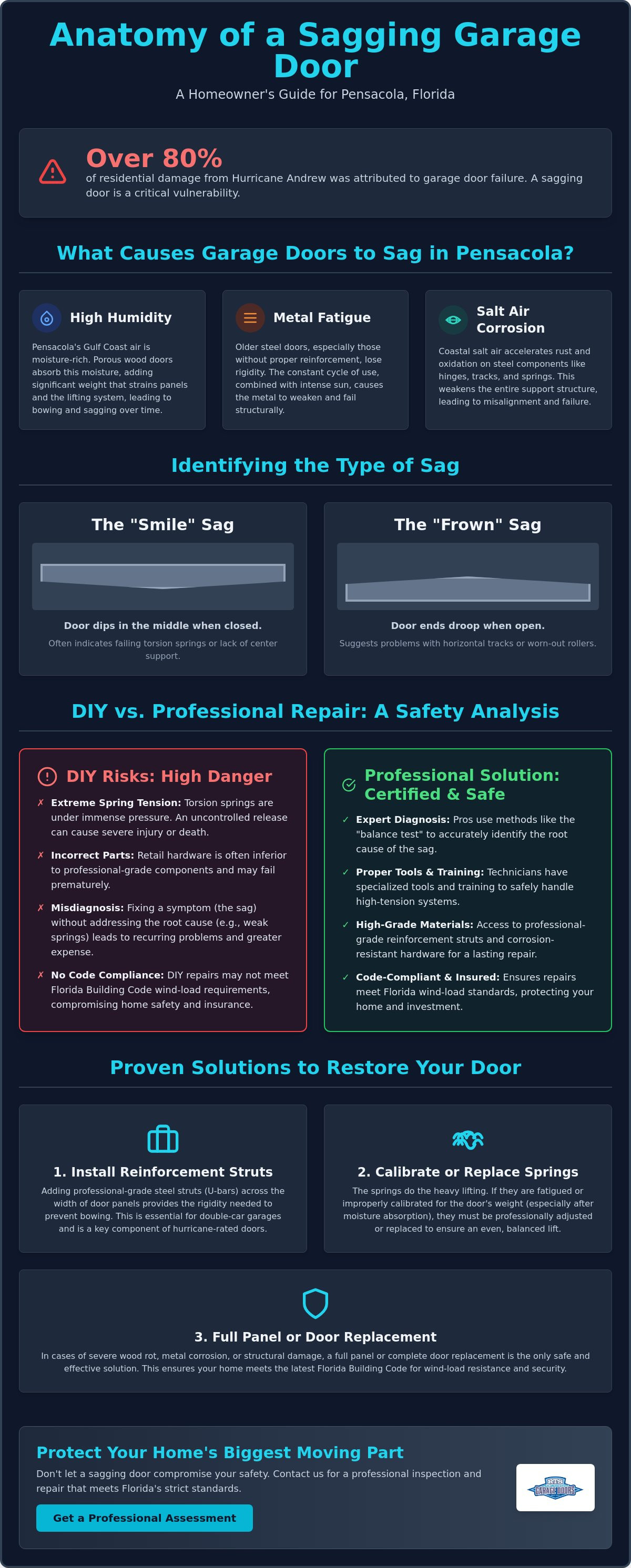
Did you know that analysts attributed over 80% of the residential damage from Hurricane Andrew to the failure of garage doors? In Florida, a sagging door is more than just an eyesore. It's a structural vulnerability that compromises your home’s safety. If you need to fix sagging garage door Pensacola issues, you aren't just fighting gravity. You're likely dealing with the relentless Gulf Coast humidity that causes wood rot and metal fatigue over time.
We understand how frustrating it's to deal with a door that sticks, groans, or looks completely uneven from the street. You want a home that looks sharp and a door that opens reliably every single time. This guide will help you identify the root cause of that unsightly dip and show you the most effective ways to restore your door’s function and security. We'll break down whether your system needs a simple reinforcement or if it's time for a professional replacement that meets the latest Florida Building Code wind-load requirements.
Key Takeaways
- Identify how Pensacola's high humidity leads to moisture absorption and structural sagging in older wood and metal doors.
- Learn why professional-grade reinforcement struts are superior to standard retail hardware when you need to fix sagging garage door Pensacola issues.
- Understand the mechanics of torsion springs and why attempting DIY repairs on high-tension systems poses a severe safety risk.
- Discover the "balance test" method used by experts to determine if your door requires simple reinforcement or a full panel replacement.
- Ensure your repair or restoration meets the latest Florida Building Code requirements for wind-load resistance and home security.
What Causes a Sagging Garage Door in Pensacola?
A sagging garage door is a structural misalignment that usually presents as a visible dip in the top section or the center of the door. This isn't just a cosmetic issue; it indicates that the door's integrity is failing and the counterbalance system is struggling. When you need to fix sagging garage door Pensacola homes often require specific solutions tailored to our unique local climate. A door that doesn't sit level can lead to damaged tracks, burnt-out motors, or a total system failure if left unaddressed.
The Gulf Coast environment is particularly harsh on residential systems. High humidity is a primary driver of damage for older wood doors. Wood is porous, meaning it absorbs moisture from the heavy Pensacola air. This additional water weight puts immense strain on the door panels and the lifting assembly. Over time, that extra weight causes the wood to bow and sag. Metal fatigue is another major factor for homeowners with steel doors. Older steel models without proper horizontal reinforcement eventually lose their rigidity. The constant cycle of opening and closing, combined with the intense Florida sun that expands and warps materials over decades, leads to a structural failure that requires a professional eye to correct.
Common Culprits: From Hinges to Humidity
Structural issues often start small. Loose or worn-out hinges allow individual panels to shift out of alignment, creating a domino effect across the entire door. A critical component in this system is the top strut, which is a long metal bar designed to provide horizontal rigidity. If this strut is missing, damaged, or undersized for the door's weight, the top panel will buckle when the door is in the open position. Additionally, salt air corrosion is a constant threat in coastal Florida. Salt accelerates the oxidation of steel hardware, weakening hinges and tracks until they can no longer support the door's structural load. This is why we prioritize high-quality, corrosion-resistant components in every repair.
Identifying the 'Smile' or 'Frown' Sag
Professionals often look for specific patterns to diagnose the issue quickly. A "Smile" sag occurs when the door dips in the middle while it's closed. This usually points to a failure in the torsion springs or a lack of proper center support. Conversely, a "Frown" sag happens when the ends of the door droop while it's in the open position, which often suggests problems with the horizontal tracks or rollers. Understanding garage door mechanics is essential for a proper fix, as the solution for a track issue differs significantly from a spring problem. This visual inspection is always the first step in a professional Wayne Dalton garage door repair Pensacola, ensuring we address the root cause rather than just patching the symptoms.
The Mechanics of the Sag: Springs, Tracks, and Struts
A garage door is a precision-engineered machine. It relies on a delicate balance between weight and tension. When this balance shifts, gravity takes over. To effectively fix sagging garage door Pensacola systems, we have to look beyond the surface dip. We must examine the components that provide the lift and the backbone of the door. If any part of this mechanical chain fails, the door loses its structural integrity and begins to bow.
Why Springs Matter for a Level Door
Springs are the muscles of your garage door. Torsion springs, located on a bar above the door opening, twist to provide torque. Extension springs, usually found on older or smaller doors, stretch along the upper horizontal tracks. If a spring loses its tension or begins to fatigue, it won't lift the door evenly. This imbalance forces the center or one side to hang lower than the rest. Proper spring tension must be precisely calibrated to the specific weight of Wayne Dalton steel panels to ensure a level, effortless lift. When springs aren't pulling their weight, the door panels bear the brunt of the load, leading to a permanent sag.
The Role of Reinforcement Struts
Think of reinforcement struts, often called U-bars, as the door's skeleton. These long metal bars run the entire width of the door panels to prevent them from bowing under their own weight. Wider doors, like those on double-car garages, are much more prone to sagging because the distance between the supports is greater. In our coastal environment, hurricane-rated doors often utilize extra struts to meet strict wind-load requirements. These additional bars provide the necessary rigidity to withstand both gravity and high-velocity winds. Without these struts, even a high-quality door will eventually succumb to the "smile" or "frown" patterns mentioned earlier.
Beyond the door itself, the track and opener play significant roles. If the tracks are misaligned, the door can "settle" into a crooked or sagging position during its travel. Your opener also contributes to the problem if the "travel limits" are set incorrectly. If the motor pushes too hard against the floor or pulls too aggressively on the top panel, it creates physical stress that eventually causes the panel to buckle. Following federal safety standards for opener installation is vital to prevent this mechanical strain and ensure long-term reliability. If you notice your door isn't moving smoothly or looks uneven, a quick inspection by a local expert can prevent a minor sag from becoming a major structural failure.
DIY vs. Professional Garage Door Repair: Is it Safe?
Many homeowners are tempted to visit a local hardware store when they notice a visible dip in their door panels. They assume a few generic brackets or a DIY bracing kit will fix sagging garage door Pensacola problems. This is a risky misconception. A sagging door represents a structural failure that generic hardware isn't designed to handle. Adding unrated weight to your door often backfires. It increases the load on your LiftMaster belt drive opener without actually solving the underlying rigidity issue.
The most significant danger lies in the door's counterbalance system. Torsion springs operate under hundreds of pounds of tension. Attempting to adjust these without specialized tools and training is incredibly dangerous. Professional technicians use high-grade winding bars and follow specific safety sequences that go beyond routine garage door maintenance. At RTS All American Garage Doors, we prioritize your safety and peace of mind. We utilize a standardized pricing structure for all our service calls. This ensures you receive honest, expert care without the stress of hidden fees or surprise costs.
Beyond physical safety, professional diagnostics protect your financial investment. When a door sags, it becomes "heavy" to the opener. This forces your motor to pull harder, which can quickly burn out the gears or the circuit board. By identifying whether you need a torsion spring replacement or a track realignment early on, we prevent a minor sagging issue from turning into an expensive opener replacement. We focus on long-term value, ensuring every component of your residential system works in harmony.
What You Can Safely Check Yourself
- Inspect and tighten any visible bolts on the hinges, but never touch the bolts on the bottom bracket where the lift cables are attached.
- Look for debris or buildup in the tracks and check if your rollers are flat or cracked.
- Test the door's balance by pulling the emergency release cord and lifting the door halfway; it should stay in place if the springs are functional. Only do this if the door isn't visibly hanging by a thread.
When to Call the Pros at RTS All American
- If you heard a loud "bang" from the garage recently, which usually indicates a broken torsion or extension spring.
- When you see the door panels pulling away from the vertical tracks or the top header.
- If the door feels too heavy to lift manually or your LiftMaster chain drive opener is making straining, grinding noises.
Proven Solutions to Straighten and Secure Your Door
Restoring a sagging door requires a systematic approach that addresses both the visible dip and the underlying mechanical strain. To effectively fix sagging garage door Pensacola systems, we follow a strict five-step restoration process. First, we conduct a balance test. By disconnecting the opener and lifting the door manually, we can tell if the springs are providing enough lift. If the door feels heavy or slams down, the springs aren't doing their job and the panels will continue to bow.
Second, we install or replace heavy-duty reinforcement struts across the top and middle panels. These act as a backbone for the door. Third, we check the track alignment. Tracks must sit in a perfectly vertical plane so the door doesn't "settle" into a crooked position during travel. Fourth, we adjust the LiftMaster opener settings. If the opener is over-compressing the door against the concrete floor, it will eventually cause the panels to buckle under the pressure. Finally, if the structural integrity is too far gone due to rot or severe metal fatigue, we replace the damaged panels to ensure the entire system is safe and secure.
Adding Reinforcement Struts
For many steel doors, adding a single 22-gauge reinforcement strut can eliminate a minor sag. These struts provide the horizontal rigidity needed to stop the structural dipping we discussed earlier. We place these bars strategically to maximize support without overloading the motor with unnecessary weight. This is why hurricane proof garage door installation often includes these struts as standard equipment. They don't just stop sagging; they help your door withstand the high-velocity winds common along the Gulf Coast.
Opener and Spring Adjustments
Mechanical tuning is just as important as structural bracing. We fine-tune the force settings on your LiftMaster unit to ensure it stops exactly where it should, preventing unnecessary panel bowing. Over time, even high-quality springs can settle, so re-tensioning them is a key part of the process. Investing in a professional garage door tune-up service is the best way to prevent future sags and extend the life of your entire system. If your door is starting to dip, don't wait for it to fail completely. Contact our team today to schedule a structural inspection and get your door back on track.
Professional Restoration with RTS All American Garage Doors
Choosing the right team to fix sagging garage door Pensacola systems means finding a provider who understands our local environment. At RTS All American Garage Doors, we've spent over 18 years serving the Pensacola and Gulf Breeze area. We know that the Florida coast presents unique challenges, from salt air corrosion to the extreme humidity that warps heavy wood panels. Our technicians are specialists in Wayne Dalton and LiftMaster systems, ensuring that your repair isn't just a temporary fix but a long-term restoration of your home’s security and curb appeal.
We operate on a 'No-Surprise' pricing model. You deserve to know exactly what you're paying for before the work begins. We provide transparent labor rates and part costs, acting as a verbal handshake with every homeowner we serve. This commitment to integrity has earned us a 4.9-star average rating from over 315 Google reviews. We don't use vague estimates or hidden surcharges because we value our reputation in the Pensacola community more than a quick profit. When we arrive at your home, we bring technical proficiency and a disciplined approach to every residential system.
Why Pensacola Homeowners Trust Us
Our customers value neighborly reliability. When you call us, you'll speak with local technicians who answer the phone live. We don't use faceless call centers or automated loops. We provide fast response times for Gulf Breeze, Navarre, and Pensacola Beach, ensuring that your home remains secure. Our team is committed to traditional craftsmanship and honest service, treating your garage door with the same care we'd give our own. We understand the latest 8th Edition of the Florida Building Code, so every repair we perform helps your door stand up to the high wind-load requirements of our coastal region.
Schedule Your Inspection Today
A sagging door is a warning sign. If you ignore a dipping panel now, you risk a total door collapse or a burnt-out motor later. Acting early saves you money and prevents potential injury. We offer a full suite of services to address every point of failure, from torsion spring replacement to professional LiftMaster garage door openers installation. Whether your door needs a heavy-duty reinforcement strut or a complete panel restoration, we have the tools and expertise to do the job right the first time. Don't let a structural issue compromise your home. Contact RTS All American for an expert diagnostic call today.
Restore Your Home’s Security and Curb Appeal
A sagging garage door is a structural warning you shouldn't ignore. Whether your door is suffering from Gulf Coast humidity or fatigued torsion springs, the key is to act before the system fails completely. You've learned that adding reinforcement struts and calibrating spring tension are the most effective ways to fix sagging garage door Pensacola issues. These steps don't just improve your home's appearance; they ensure your family's safety and help your home meet Florida's strict wind-load standards.
At RTS All American Garage Doors, we bring over 18 years of local experience to every service call. As certified Wayne Dalton and LiftMaster experts, we provide the technical precision your residential system requires. We stand by our standardized pricing model with no hidden fees, giving you the transparency you deserve. Don't let a dipping panel turn into a costly collapse. Schedule Your Professional Garage Door Repair in Pensacola Now and get your door back to peak performance. We're ready to help you secure your home with honesty and pride.
Frequently Asked Questions
Is a sagging garage door dangerous?
Yes, a sagging garage door is a serious safety hazard that requires immediate attention. When a door loses its structural integrity, it places uneven weight on the tracks and rollers, which can cause the door to jump its tracks or fall unexpectedly. Additionally, the extra strain on your opener motor can lead to electrical failure or snapped cables. Addressing these issues early is the best way to avoid injury or a total system collapse.
Can I fix a sagging garage door by myself?
You should not attempt to fix major structural sagging on your own due to the extreme risks involved. While tightening a few hinge bolts is safe, adjusting torsion springs or installing heavy reinforcement struts requires specialized tools and technical knowledge. The high tension in the spring system can cause severe injury if handled incorrectly. It's always safer to have a professional technician evaluate the system to ensure the repair meets local safety standards.
How much does it cost to fix a sagging garage door in Pensacola?
The cost to fix sagging garage door Pensacola issues depends entirely on the root cause, such as whether you need a simple strut installation or a full spring replacement. Every situation is unique, so we perform a detailed inspection to identify which components have failed. We believe in transparency, which is why we provide a clear explanation of the necessary parts and labor before any work begins on your residential system.
Will a new strut fix my sagging door?
A heavy-duty reinforcement strut can often correct a minor sag in steel doors by providing the necessary horizontal rigidity. These U-bars act as a backbone, pulling the panels back into a level position. However, if the door panels are already cracked or the springs are fatigued, a strut may only be a temporary patch. A professional assessment will determine if a strut is sufficient or if other mechanical adjustments are required to fix sagging garage door Pensacola problems.
Do I need to replace the whole door if it's sagging?
You don't always need a full replacement just because your door is sagging. If the structural damage is limited to a single section, we can often perform a garage door panel replacement to restore the door's integrity. Reinforcement struts and spring adjustments can also save an otherwise healthy door. We only recommend a full replacement if the cost of multiple repairs exceeds the value of a new, wind-rated system that meets current Florida Building Codes.
How do I know if my garage door springs are causing the sag?
You can check your springs by performing a manual balance test. Disconnect your opener and lift the door halfway; if it doesn't stay in place or feels incredibly heavy, your springs are likely fatigued and causing the sag. When springs lose their tension, they fail to support the door's weight evenly, leading to visible dipping. If your door fails this test, it's time to call for a professional spring inspection to prevent further damage to your panels.
Can humidity in Florida cause my garage door to warp?
Yes, the intense humidity along the Florida coast is a leading cause of warped and sagging doors. Wood doors are particularly vulnerable because they absorb moisture from the air, which increases their weight and causes the material to bow over time. Even steel doors can suffer if the humidity leads to salt air corrosion on the internal reinforcement. Choosing moisture-resistant materials and maintaining proper weather seals is essential for homeowners in our local climate.
What is the best way to prevent my garage door from sagging in the future?
The best way to prevent future sagging is to schedule regular professional tune-ups. Routine maintenance allows technicians to catch loose hinges, misaligned tracks, and weakening springs before they cause structural damage. Keeping your rollers lubricated and ensuring your opener's travel limits are set correctly will also reduce the physical stress on your panels. A proactive approach is the most cost-effective way to ensure your door remains level and functional for years to come.