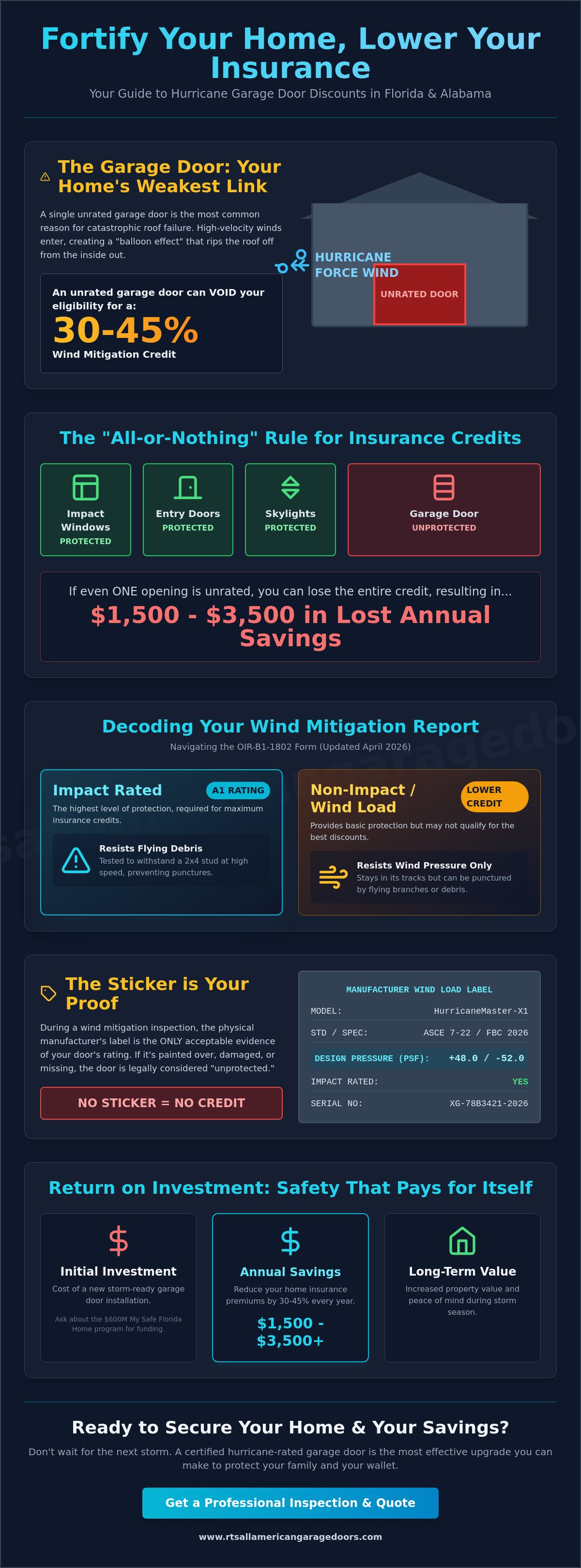
A single unrated garage door can completely void your eligibility for a 30% to 45% wind mitigation credit, even if every other window and door in your home is impact-rated. For homeowners in Florida and Alabama, the garage door is often the weakest link that triggers catastrophic roof failure during a storm. If you're tired of watching your premiums climb, securing a hurricane garage door home insurance discount is the most effective way to fight back. We understand the frustration of navigating the April 2026 updates to the Florida Wind Mitigation form or trying to decode Alabama's Fortified Home requirements.
You deserve a home that is both safe and affordable. This guide will show you exactly how to transform your garage into a certified shield that lowers your annual bills. We'll preview the new $600 million funding for the My Safe Florida Home program, explain the stricter documentation rules on the OIR-B1-1802 form, and provide clear steps to pass your next inspection. From understanding ASCE 7-22 wind load standards to maximizing your ROI, you'll gain the technical clarity needed to protect your family and your wallet.
Key Takeaways
- Understand why the garage door is the "weakest link" and how securing it prevents the internal pressurization that leads to catastrophic roof failure.
- Learn how to navigate the 2026 updates to the Florida wind mitigation form and the specific "Opening Protection" ratings required for maximum credits.
- Compare the unique wind-speed requirements for Pensacola and Baldwin County to ensure your installation complies with the latest local resilience standards.
- Use our readiness checklist to verify manufacturer labels and reinforcement struts, ensuring you successfully claim your hurricane garage door home insurance discount.
- Calculate the long-term return on investment by balancing the cost of a new storm-ready door against annual premium reductions and increased property value.
Why Your Garage Door is the Key to Home Insurance Discounts
Gulf Coast homeowners face a challenging insurance market where premiums often range from $3,000 to $6,000. One of the most effective ways to lower these costs is by securing a hurricane garage door home insurance discount. This credit isn't a courtesy from your agent; it's a state-mandated requirement for homes that meet specific resilience standards. The April 2026 update to the Florida wind mitigation form (OIR-B1-1802) introduced stricter documentation rules, meaning you need verified proof of your door's strength to see any savings.
To unlock these discounts, you'll need to schedule a wind mitigation inspection. This certified report proves to your carrier that your home is hardened against storm-force winds. Since wind insurance costs have spiked, percentage-based discounts are more valuable than ever. In 2026, a 30% credit on a coastal policy can save you thousands of dollars every year. Insurance carriers view unrated garage doors as major liabilities. It's the largest opening on your property and usually the most vulnerable. If the door fails, the home's structural integrity is compromised almost instantly.
The Physics of Internal Pressure
If a garage door buckles during a storm, wind enters the home at high velocity and creates a "balloon effect." Internal air pressure rises rapidly and pushes upward on the roof while external winds pull from the outside. This combination is the primary cause of total roof failure during a hurricane. A professional hurricane proof garage door installation maintains the structural envelope of your home. It keeps the pressure outside where it belongs and prevents the house from being destroyed from the inside out. Protecting this entry point is the only way to ensure your roof stays attached during a major wind event.
The 'All Openings' Rule Explained
Florida uses an "all-or-nothing" rule for opening protection credits. To receive the highest discount, every window, door, and skylight must be impact-rated or protected. If you've upgraded your windows but left an unrated garage door in place, you'll likely lose the entire credit. In high-premium coastal counties, a single unrated opening can result in $1,500 to $3,500 in lost annual savings. You can't afford to leave one hole in your home's armor. The garage door must be part of the package to satisfy the inspector and the insurance company's underwriters.
Understanding Wind Mitigation Inspections and Ratings
The OIR-B1-1802 Wind Mitigation Inspection form is the primary document that determines your eligibility for a hurricane garage door home insurance discount. Following the April 2026 update, inspectors must provide more detailed photographic evidence and documentation than in previous years. Section 7 of this form, titled "Opening Protection," is where your garage door's performance is officially recorded. The inspector will check if the door is rated for wind-borne debris or just wind pressure. If your door doesn't meet the specific criteria for your wind zone, you'll likely miss out on the most significant credits.
There's a critical difference between "Impact Rated" and "Non-Impact Wind Load" doors that homeowners often overlook. An impact-rated door is tested to survive a direct hit from flying debris, such as a 2x4 stud traveling at high speed. A non-impact wind load door is engineered to stay in its tracks under extreme pressure but can still be punctured by a flying branch. To qualify for the highest "A1" rating on the Florida inspection form, every opening in your home must meet the impact standard. If you're unsure where your current system stands, you can request a professional inspection of your door's hardware to see if it meets 2026 requirements.
Decoding the Wind-Load Sticker
You can usually find the manufacturer's label on the inside edge of the door panels or on the bottom section. This sticker is your most valuable piece of evidence during a wind mitigation check. It lists the PSF (Pounds per Square Foot) rating, which tells the inspector exactly how much pressure the door can handle. For example, a door rated at 48 PSF is built to withstand much higher wind speeds than a standard 30 PSF model. If you've painted over this sticker or if it has peeled off over time, the inspector cannot verify the rating. Without that physical label, the door is legally considered "unprotected," regardless of its actual strength.
The Role of Professional Certification
Don't rely on DIY reinforcement kits or aftermarket braces from big-box stores to lower your premiums. While these might add some structural support, they rarely come with the Florida Building Code (FBC) product approval numbers required for the wind mitigation form. Insurance companies demand factory-certified systems that have undergone rigorous laboratory testing. Wayne Dalton classic steel doors are a prime example of engineered products that come with the necessary FBC certifications. These doors provide the verifiable paper trail that underwriters require to grant your discount.
Local Codes: Pensacola vs. Baldwin County Requirements
The rules for securing a hurricane garage door home insurance discount change significantly as you cross the Perdido River. While both regions face high wind risks, Florida and Alabama use different frameworks to verify home resilience. In Florida, the standards are driven by the Florida Building Code (FBC) and the wind mitigation inspection process. Alabama homeowners rely more heavily on the Fortified Home program. Understanding these local nuances is essential because a door that passes inspection in one county might not meet the stricter wind-borne debris requirements of a coastal barrier island.
In Pensacola and Gulf Breeze, the 2026 wind-speed requirements typically range from 140 to 150 mph. If your home is located within one mile of the coast in Baldwin County, Alabama, local building codes updated in 2024 now mandate wind-borne debris protection for all new construction. This means your garage door must be able to withstand both the pressure of the wind and the impact of flying objects. Whether you live in Perdido Key or Orange Beach, your proximity to the water dictates the specific Pounds per Square Foot (PSF) rating your door requires to be considered "protected" by your insurance carrier.
Florida’s Wind Mitigation Mandate
Florida law requires insurance companies to offer discounts for homes with certified wind-mitigation features. This mandate is designed to encourage homeowners to harden their properties against the catastrophic storms that frequent the Gulf. Residents on Pensacola Beach face the strictest requirements because they live in a high-velocity wind zone where the risk of structural failure is greatest. Installing insulated garage doors in Baldwin County, AL or Pensacola provides more than just temperature control. The sandwich-style construction of these doors adds significant structural rigidity, helping the system maintain its shape under the intense pressure of a Category 4 or 5 hurricane.
Alabama’s Insurance Incentives
Alabama homeowners can access the Strengthen Alabama Homes grant program, which provides funding to help residents reach "Fortified" standards. Achieving a Bronze, Silver, or Gold Fortified designation is the most reliable way to lower your rates in Baldwin County. For a home in Gulf Shores with a $4,500 annual windstorm premium, a Fortified designation can lead to a 35% discount, saving the homeowner roughly $1,575 per year. We recommend that Baldwin County residents consult the latest ASCE 7-22 wind-speed maps to determine if their current door meets the 2026 standards for their specific neighborhood. These maps are the gold standard used by evaluators to determine if your home qualifies for mandated insurance reductions.
The Hurricane Garage Door Readiness Checklist
Before you call an inspector to secure your hurricane garage door home insurance discount, you should perform a self-assessment of your current system. Knowing what to look for can save you the cost of a failed inspection. A truly storm-ready door isn't just about the panels; it's about the entire assembly working as a reinforced unit. If your door is missing the critical hardware listed below, it won't matter how heavy the steel is; the wind will simply rip the tracks off the wall.
- Label Verification: Look for a permanent manufacturer’s sticker on the inside of the door. It must show the Wind Load rating and the Florida Building Code (FBC) or Miami-Dade approval number.
- Strut Count: Check for horizontal U-shaped metal bars (struts) running across the width of the panels. A hurricane-rated door typically has at least one strut per panel, though high-pressure zones require more.
- Track Gauge: Inspect the thickness of the vertical tracks. Standard doors use thin 18-gauge steel, but hurricane-resistant systems require heavy-duty 14-gauge steel tracks to prevent twisting under load.
- Mounting Hardware: Verify that the track brackets are bolted directly into the structural wooden jambs or masonry. Screws that only grab into drywall or thin trim will pull out instantly during a storm.
- Roller Integrity: Look for "long-stem" rollers. These have longer shafts that stay inside the track even when the door panels flex under extreme pressure.
If your hardware doesn't meet these standards, your home remains at risk. You can schedule a professional hardware evaluation to identify exactly which components need upgrading to meet 2026 insurance requirements.
Visual Inspection of the Door System
Walk your garage and look closely at the panel faces. Hairline cracks near the hinges or center stiles indicate metal fatigue. In coastal areas like Gulf Breeze, salt-air corrosion is a silent killer for garage door integrity. Check for white oxidation on aluminum parts or red rust on steel hinges and springs. Don't ignore loose bolts. A single vibrating bolt can wallow out a hole over time, creating a weak point that fails when the wind starts pushing against the door face.
Testing the Seal and Balance
Close your door and look for light leaking in at the bottom or sides. If you see daylight, wind-driven rain and air pressure can get inside. Brittle or rotted weatherstripping needs immediate replacement to maintain the structural envelope. Finally, perform a balance test. Disconnect the opener and lift the door halfway by hand. If it slams down or shoots up, the springs are improperly tensioned. An unbalanced door puts uneven stress on the tracks, making them more likely to buckle during a high-pressure event.
ROI: Calculating Your Savings and Next Steps
Investing in a hurricane-rated garage door is one of the few home improvements that offers a documented financial return. In high-premium coastal counties, a new installation can pay for itself in as little as 12 to 24 months through a hurricane garage door home insurance discount. Beyond the annual premium cuts, you're also protecting yourself from massive out-of-pocket expenses. With hurricane deductibles typically set at 2% to 5% of your home's value, a single storm could cost you $8,000 to $20,000 before your insurance pays a dime. A reinforced door prevents the structural failure that triggers these devastating claims.
Resale value is another critical factor for Gulf Coast homeowners in 2026. Potential buyers are increasingly savvy about insurance costs and wind mitigation ratings. A "Storm Ready" certification acts as a seal of quality that can distinguish your property in a competitive market. It provides peace of mind to buyers who don't want to inherit skyrocketing premiums. Upgrading now is also a strategic move to beat the December 31, 2026, implementation of the 9th Edition Florida Building Code, which will likely push equipment and labor costs higher as demand surges for compliant systems.
How to File for Your Discount
Claiming your savings is a straightforward process, but it requires precision. First, ensure your new installation includes all necessary FBC or Fortified Home documentation. Once the door is in place, you'll need to hire a licensed inspector to complete the OIR-B1-1802 form or the Alabama equivalent. While an inspection carries a small upfront cost, the long-term savings usually dwarf this fee within the first year. At RTS All American Garage Doors, we believe in labor transparency and standardized pricing. We provide the exact technical specifications your inspector needs, ensuring there are no hurdles when you submit the paperwork to your insurance agent.
Schedule Your Professional Assessment
Don't wait until a named storm is churning in the Gulf to check your home's defenses. The hurricane season begins on June 1st, and lead times for custom-rated doors often increase as the deadline approaches. The technicians at RTS All American Garage Doors are local experts who live in the same Florida and Alabama neighborhoods they serve. They understand the specific wind-load requirements for your street and won't use high-pressure sales tactics or hidden surcharges. We treat every home with the same level of care we'd give our own families.
Take the first step toward a more resilient home and a lower insurance bill today. Get a professional hurricane-rated garage door assessment from RTS All American Garage Doors and secure your property for the 2026 season.
Secure Your Home and Your Budget for the 2026 Season
Securing a hurricane garage door home insurance discount isn't just about paperwork; it's about making sure your largest opening doesn't become your home's biggest liability. You've seen how a single unrated door can disqualify you from major credits and leave your roof vulnerable to catastrophic internal pressure. By following the readiness checklist and verifying your PSF ratings, you're taking direct control of your home's safety and your financial future. These upgrades offer a rare opportunity to increase your property value while forcing your insurance premiums down.
Our expert technicians have spent over 15 years serving neighbors across Pensacola and Baldwin County. We specialize in Wayne Dalton hurricane-rated systems and maintain a strict commitment to standardized pricing with no hidden surcharges. This transparency is our verbal handshake with the community. Don't let another storm season pass with an unrated system that drains your bank account through high premiums and high risks. Protect your home and lower your premiums-request a storm-ready quote today! We look forward to helping you pass your next inspection with confidence.
Frequently Asked Questions
How much of an insurance discount can I get for a hurricane garage door?
Florida homeowners can receive discounts ranging from 30% to 45% on the wind portion of their premiums when every opening is protected. In Alabama, homes certified under the Fortified program often see 20% to 50% reductions. The specific savings depend on your distance from the coast and your home's total insured value.
Can I just use a manual brace to get the insurance discount?
Manual braces rarely qualify for the maximum hurricane garage door home insurance discount because they lack a permanent Florida Building Code (FBC) approval number. Insurance carriers prefer factory-certified doors that have passed laboratory pressure testing. Braces also require manual installation before a storm, which underwriters view as a higher risk than a permanently reinforced door.
What is the OIR-B1-1802 form and why do I need it?
The OIR-B1-1802 is the official Florida Wind Mitigation Inspection form used to document a home’s structural resilience. You need this form because insurance companies require a licensed inspector to verify your garage door’s PSF rating and mounting hardware before they apply any credits. The form was updated in April 2026 to include stricter documentation and photographic evidence requirements.
Do I need to replace my opener when I get a hurricane-rated door?
You don't always have to replace the opener, but we highly recommend it. Hurricane-rated doors use heavier steel and additional reinforcement struts, which significantly increases the weight. A heavy-duty LiftMaster belt or chain drive opener is designed to handle this extra load and ensures the system operates reliably during daily use without burning out the motor.
What is the difference between wind-load and impact-rated doors?
Wind-load doors are reinforced to stay in their tracks under extreme pressure, while impact-rated doors are tested to survive direct hits from flying debris. To qualify for the highest "A1" rating on a wind mitigation report, your door must typically meet the impact standard. This ensures the structural envelope of your home remains sealed even if a branch or tile strikes the door.
Will my insurance company pay for the new garage door?
Insurance companies generally don't pay for preventative upgrades; they only cover replacements after a storm causes damage. However, you can offset the cost through state-funded initiatives like the My Safe Florida Home program or the Strengthen Alabama Homes grant. These programs provide specific funding for homeowners who are retrofitting their properties to meet modern resilience standards.
How long does a wind mitigation inspection take?
A professional wind mitigation inspection usually takes between 45 and 60 minutes. The inspector spends a significant amount of time in the garage verifying manufacturer stickers, checking track gauge, and confirming that the mounting brackets are secured into structural jambs. Clearing a path to your garage door hardware before the inspector arrives will help the process move more efficiently.
Is Baldwin County's 'Fortified' standard different from the Florida Building Code?
Yes, they use different frameworks for certification. Florida relies on the Florida Building Code and the OIR-B1-1802 form to trigger discounts. Baldwin County uses the IBHS Fortified Home standard, which requires a certified evaluator to designate a home as Bronze, Silver, or Gold. Both programs require a rated garage door, but the documentation you provide to your insurance agent differs by state.