Did you know that over 1,600 injuries occur every year in the U.S. during garage door maintenance? Most homeowners don't realize they're dealing with a high-tension system until a component snaps. If you're currently staring at a door that won't budge while your car is trapped inside, you're likely feeling a mix of frustration and worry. You might be wondering if your motor is burned out or if you're facing a major repair. Learning how to tell if garage door spring is broken is the first step toward getting your day back on track safely.
It's completely normal to feel uncertain when your home's largest moving part stops working. We'll help you identify the exact signs of a snapped spring so you can stop guessing and start making an informed decision for your family's safety. This guide covers five critical warning signs of spring failure and the essential steps you must take to prevent a catastrophic door collapse. From visual gaps in the metal coil to the specific sound of a failing torsion system, you'll gain the clarity you need to handle this situation with confidence and find a repair expert who values transparency.
Key Takeaways
- Identify the specific visual cues, such as a two-inch gap in the torsion coil or loose, unraveled cables, that signal a major mechanical failure.
- Understand the serious safety risks involved and why you should never pull the red emergency release cord when a spring is snapped.
- Learn how to tell if garage door spring is broken by recognizing the difference between a simple motor glitch and a high-tension spring snap.
- Discover why matching the exact wire size and length is critical for the long-term performance of specialized Wayne Dalton and LiftMaster systems.
- Gain peace of mind by knowing when to step back and let a professional handle the dangerous counterweight of your garage door.
What Happens When a Garage Door Spring Breaks?
Your garage door doesn't actually rely on the motor to do the heavy lifting. Instead, it uses a complex counterweight system designed to offset the total weight of the door, which typically ranges from 150 to over 400 pounds. The springs are the heart of this system. They store immense amounts of energy in the form of torque, even when the door is completely closed. When you're trying to figure out how to tell if garage door spring is broken, the most obvious sign is often a door that suddenly feels like a ton of bricks.
If a spring snaps, the opener motor might still hum or struggle, but the door will likely only move an inch or two before the safety sensors or the motor's force settings stop the cycle. This happens because the dead weight of the steel or wood panels is no longer being supported. Without that mechanical assistance, even a high quality LiftMaster motor cannot safely move the door. Attempting to force the door open in this state can quickly burn out your motor's gears, turning a spring repair into a much more expensive equipment replacement.
The Role of the Counterweight System
A standard 1/2 horsepower LiftMaster motor is designed to guide the door along its tracks, not to hoist 300 pounds of Wayne Dalton steel on its own. The springs do the work by providing an equal and opposite force to the door's weight. Most residential systems utilize torsion and extension springs to achieve this balance. A single sentence defines the cycle life of a standard torsion spring: it is typically rated for 10,000 cycles, which translates to roughly 7 to 10 years of normal use for the average household. Once the metal reaches its fatigue point, it will fail, usually without any prior warning.
The Sudden Sound of Failure
The acoustic signature of a breaking spring is unmistakable. Because the spring is under hundreds of pounds of tension, the moment the steel coils snap, they release all that energy at once. This creates a loud bang or crack that many homeowners mistake for a gunshot or a heavy object falling in the garage. Since the garage is a hollow, echoing space, the sound often carries throughout the entire house.
You might hear this noise even if you aren't in the garage at the time. It's a much sharper, more violent sound than a cable popping off a drum or a roller jumping the track. While a cable failure might cause the door to sag or hang crookedly, a broken spring effectively disconnects the door's weight from the lifting mechanism entirely. Knowing these mechanical basics is the first step in understanding how to tell if garage door spring is broken before you accidentally damage your opener motor by forcing it to run.
5 Visual Signs Your Garage Door Spring is Broken
Visual inspections are the most reliable way to confirm a mechanical failure. While the loud noise mentioned previously is a major clue, you can often see the damage without touching a single component. In coastal environments like Pensacola or Mobile, salt air and high humidity often accelerate metal corrosion. This rust weakens the steel coils over time, making them far more likely to snap unexpectedly. If you suspect an issue, start by looking for these five specific indicators to learn how to tell if garage door spring is broken.
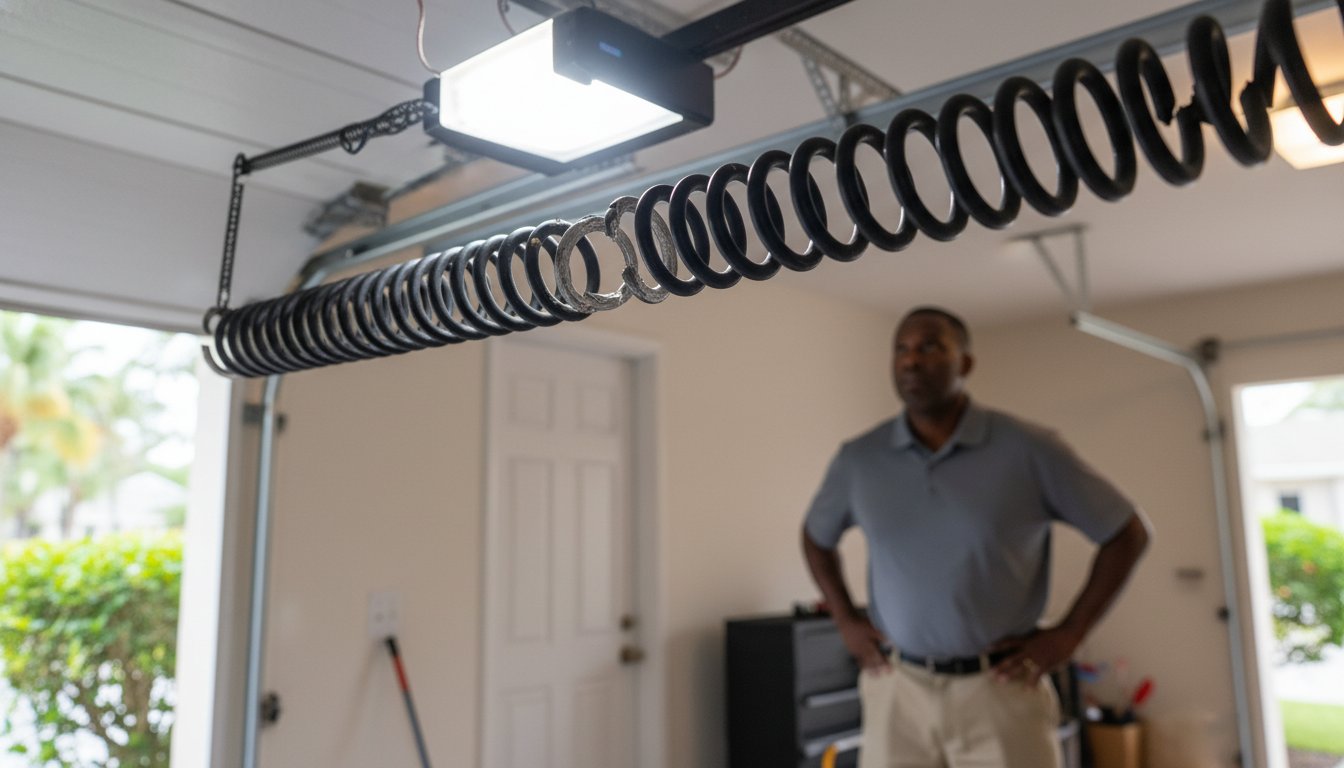
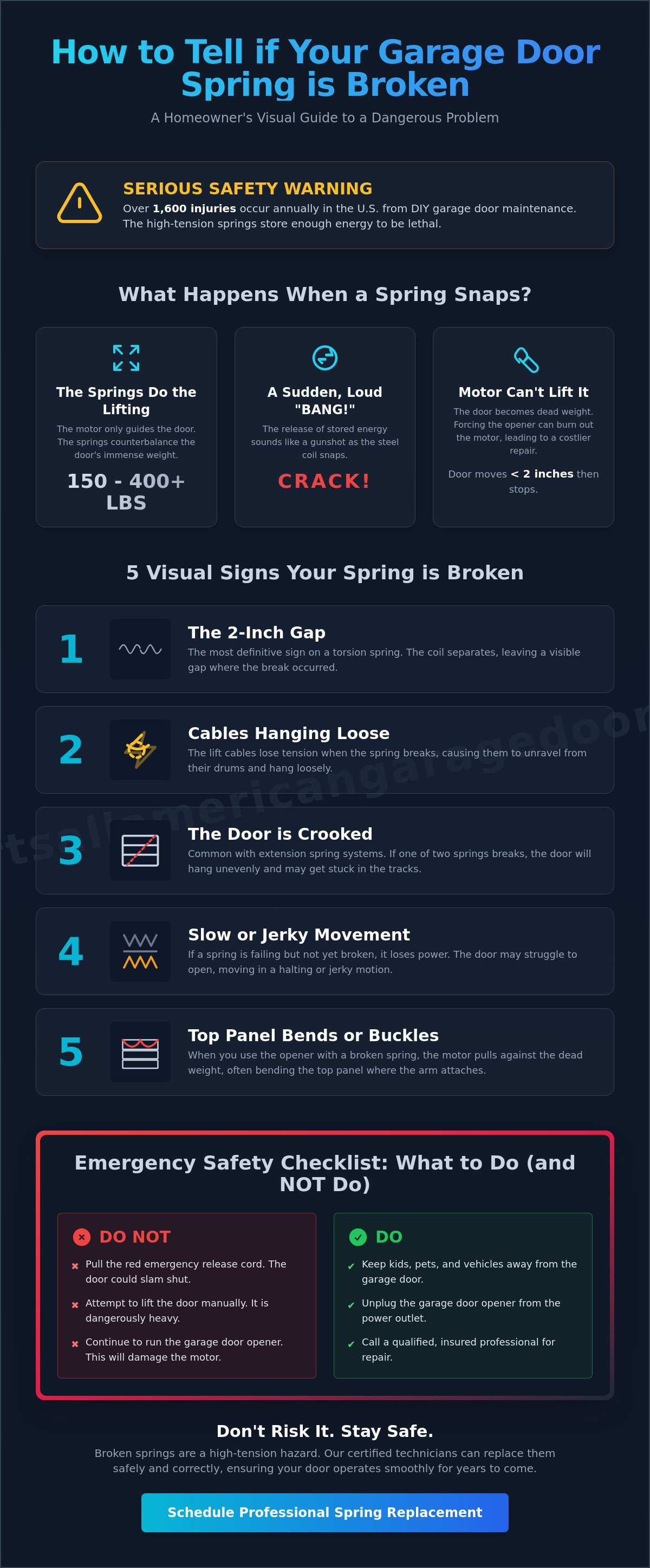
- The 2-Inch Gap: This is the most definitive proof in a torsion system. When the spring snaps, the two sides of the coil pull away from each other, leaving a clear gap of two or more inches.
- Cables Hanging Loose: Your lift cables rely on spring tension to stay on their drums. When a spring breaks, that tension vanishes, causing the cables to unravel and hang like loose pieces of string.
- The Crooked Door: Extension spring systems usually have one spring on each side. If only one side breaks, the door will pull unevenly, causing it to look tilted or get stuck at an angle in the tracks.
- Slow or Jerky Movement: If the door struggles to rise or moves in a halting, jerky motion, the spring may be severely stretched or partially failed. This is a sign the metal is nearing its breaking point.
- The Top Section Bend: If you try to open a door with a broken spring using an automatic opener, the motor pulls against the dead weight of the door. This often causes the top panel to bend or buckle where the opener arm attaches.
Identifying these issues early can prevent further damage to your tracks or motor. If you notice any of these signs, it's best to contact a professional for expert spring replacement before the situation worsens.
Identifying Torsion Spring Gaps
To find a torsion spring, look at the metal shaft located directly above the garage door header. These springs are wrapped tightly around the bar. A broken torsion spring will show a clean, jagged break in the black or galvanized steel coil. Because these components are under extreme tension, you should never attempt to touch, measure, or adjust this gap yourself. The dangers of spring failure are significant, as the remaining tension can cause the spring to shift violently if disturbed.
Extension Spring Warning Signs
Extension springs are located along the horizontal tracks near your garage ceiling. Instead of a gap, look for "stretched" coils that appear elongated or distorted. These springs should be uniform in shape; if they look like a slinky that has been pulled too far, they no longer have the strength to lift the door. Check for the presence of safety cables running through the center of the coils. If these cables are missing or frayed, a snapping extension spring can become a dangerous projectile, causing injury or property damage.
The Difference Between Torsion and Extension Springs
Understanding which system you have is the first step in learning how to tell if garage door spring is broken. Most residential homes use either torsion springs or extension springs to handle the heavy lifting. Torsion springs are mounted on a metal bar directly above the garage door header. Extension springs, on the other hand, are located on the sides of the door and run parallel to the horizontal tracks near the ceiling. While both serve the same purpose, they fail in very different ways.
Torsion systems are generally considered the gold standard for durability. They offer a higher cycle life, which is the number of times a door can open and close before the metal fatigues. In the humid coastal climates of Pensacola and Mobile, salt air accelerates rust on standard spring wire. This corrosion is a silent killer for springs. We often see torsion springs outlast extension springs because they distribute the weight of heavy Wayne Dalton steel doors more evenly, reducing the localized stress that leads to snapping.
Why Torsion Systems are the Modern Standard
Torsion springs are the preferred choice for modern homes because of their controlled failure mechanism. If a torsion spring snaps, the metal shaft it's wrapped around keeps the broken pieces from flying across the room. This design is a critical safety feature. These systems are also a requirement for hurricane proof garage door installation. Hurricane-rated doors are significantly heavier than standard panels, and only a properly sized torsion system can provide the necessary balance to prevent your LiftMaster opener from burning out under the load.
Extension Springs and the Safety Cable Requirement
Older homes or smaller single-car garages often utilize extension springs. These act like massive rubber bands that stretch as the door closes. The primary risk with this design is the "slingshot" effect. If an extension spring fails and lacks a steel safety cable running through its center, the spring can launch across the garage with enough force to pierce a car door or cause severe injury. When inspecting these, look for rust or gaps in the side-mounted coils. If you're tired of the jerky movement and noise associated with these springs, RTS All American often recommends converting the system to a torsion setup for improved safety and long-term reliability.
Emergency Safety Checklist: What to Do (and NOT Do)
Once you've identified the signs and figured out how to tell if garage door spring is broken, your immediate priority must shift to safety. A garage door with a snapped spring is a heavy, unpredictable hazard. The tension that was once safely managed by steel coils is now gone, leaving the full weight of the door to be held only by the opener's motor or your own strength. This is a situation that requires a disciplined, no-nonsense approach to prevent injury or property damage.
Start by following these immediate safety steps:
- Disconnect the opener power: Unplug the motor from the ceiling outlet. This prevents anyone from accidentally pressing a button and burning out the motor or causing the door to move unexpectedly.
- Do NOT pull the red emergency release cord: If the door is in the "up" or partially open position, pulling this cord will disconnect the door from the motor, causing it to crash down instantly.
- Do NOT attempt to lift the door manually: A 300 pound door becomes "dead weight" without a spring. Attempting to lift it can lead to severe back injuries or crushed fingers.
- Do NOT use household tools: Never try to "wind" or adjust a garage spring with screwdrivers or pliers. These components require specialized high-torque winding bars that won't slip under pressure.
If your car is trapped inside, don't panic. The safest option is to leave the door exactly where it is until a professional arrives. Attempting a DIY "rescue" of your vehicle often results in more damage to the car's roof or the door's tracks than the cost of a professional service call.
The Danger of the Emergency Release
Many homeowners think pulling the red cord is the solution to a trapped car. In reality, this is the most dangerous move you can make. Without the counterweight of the spring, the door is in a state of "free fall." Is a broken garage spring dangerous because it can result in thousands of pounds of force crashing down in less than a second. If you must secure a partially open door, you can sometimes use heavy-duty C-clamps on the tracks directly under the rollers, but even this should be done with extreme caution.
Why Professional Repair is Non-Negotiable
Spring replacement is one of the few home repairs that is truly non-negotiable for professionals. The "Winding Bar" requirement is the main reason why. These specialized tools are designed to fit the winding cone of a torsion spring perfectly. Using a substitute can cause the spring to unwind violently, leading to limb loss or facial injury. At RTS All American, we value integrity and transparency. We offer professional spring replacement with standardized labor rates. This ensures you get your door back in working order without the fear of hidden fees or "sticker shock" during an emergency.
Professional Spring Replacement in Pensacola and Mobile
Once you've mastered how to tell if garage door spring is broken, the next step is ensuring the repair is handled with technical precision. At RTS All American, we specialize in high-performance Wayne Dalton and LiftMaster systems. These aren't generic parts; they're engineered components that must be perfectly calibrated to your door's specific weight and height. Whether you have a heavy Carriage House steel door or a standard commercial overhead door, our team brings the specialized knowledge required to restore your system's balance.
A critical part of our process is "Matching the Spring." It's a common mistake to think any spring will work as long as it fits the bar. In reality, the wire size, inner diameter, and overall length must be exact. If the new spring is even slightly off, it will either leave the door too heavy for the LiftMaster opener or make it too "hot," causing it to fly up dangerously. We use precision tools to measure your existing setup and install a replacement that meets the original manufacturer's specifications for your specific Wayne Dalton model.
Our commitment to the local community is personal. We have live technicians answering calls in Baldwin County and Pensacola, ensuring you speak to a real person who understands the urgency of a trapped vehicle. Beyond the repair, we focus on long-term value. Regular lubrication of your new springs with a high-quality silicone spray can significantly extend their lifespan by reducing friction and preventing the surface rust that leads to premature failure. This is a simple step that protects your investment and ensures smooth, quiet operation.
Standardized Pricing and Local Reliability
We believe in a "verbal handshake" approach to business. That means no hidden fees or surprise surcharges for our neighbors in Pensacola Beach and Navarre. Our pricing structure is standardized and transparent, so you know exactly what to expect before we even arrive. For those facing a total system failure, we offer same-day service availability to get your home secure again. You can find more details in our guide on Expert Garage Door Spring Repair in Mobile.
Upgrading to High-Cycle Springs
For high-traffic family garages that see constant use, we often recommend upgrading to high-cycle springs. While standard springs are rated for about 10,000 cycles, these heavy-duty alternatives are designed to handle 20,000 or more. This is especially beneficial for homes in Gulf Breeze, where we provide springs with specialized corrosion-resistant coatings to fight the aggressive salt air. Contact RTS All American Garage Doors today for a professional safety inspection and spring replacement that prioritizes your family's peace of mind.
Secure Your Home and Restore Your Daily Routine
A broken spring is more than a minor inconvenience; it's a critical safety hazard that puts your family and property at risk. By recognizing the visual gaps in your torsion coils and understanding the danger of the "free fall" effect, you've taken the first step toward a safer home. You now know how to tell if garage door spring is broken and why attempting a DIY fix with household tools is never worth the gamble. Precision matters when dealing with high-tension steel, especially in our humid coastal environment where corrosion is a constant threat.
RTS All American Garage Doors has been family-owned and operated for over 15 years. We pride ourselves on integrity and technical excellence. Our live, local technicians answer every call, providing the specialized expertise needed for Wayne Dalton and LiftMaster systems. We don't use vague estimates; we provide the honest, standardized pricing you deserve. Don't let a snapped spring keep your car trapped or your home vulnerable. Schedule Your Emergency Spring Repair with RTS All American today. We're ready to get your door back on track with the traditional service values you can trust.
Frequently Asked Questions
Can I open my garage door with a broken spring?
No, you should not attempt to operate the door once a spring has failed. The spring acts as the counterweight for the door's mass; without it, the door is essentially dead weight. Forcing a LiftMaster opener to lift a 300 pound door can quickly burn out the motor's gears or cause the lift cables to snap. Manual lifting is also dangerous and can lead to severe back strain or crushed fingers.
How much does it cost to fix a broken garage door spring in Pensacola?
Professional repair costs depend on several factors, including the weight of your door and whether you have a torsion or extension system. While industry averages for Florida provide a general baseline, specific rates vary based on the wire size and length required for your system. You should look for a provider that offers standardized labor rates and transparent pricing to avoid the "sticker shock" of hidden emergency fees.
Should I replace both garage door springs if only one is broken?
Yes, you should always replace springs in pairs. Most garage doors are installed with two springs that share the workload equally and experience the same number of cycles. If one has reached its fatigue point and snapped, the other is likely just a few weeks away from failing. Replacing both at once ensures the door remains perfectly balanced and saves you the cost of a second service call in the near future.
How long does it take for a professional to replace a garage door spring?
A standard residential spring replacement typically takes an experienced technician between 30 and 60 minutes. This timeframe includes removing the broken coils, installing the new hardware, and using professional winding bars to set the correct tension. If your system requires additional work, such as cable repair or track realignment, the process may take slightly longer to ensure everything is calibrated correctly.
What caused my garage door spring to snap suddenly?
The primary cause of spring failure is simple metal fatigue. Most residential springs are rated for approximately 10,000 cycles. Once the steel reaches its limit, it becomes brittle and snaps. In our local coastal environment, salt air corrosion often accelerates this process. Rust creates microscopic pits in the metal that act as stress points, leading the spring to fail much earlier than a spring in a drier, inland climate.
Is it safe to leave a broken garage door spring overnight?
It is safe to leave the door as it is, provided the door is in the fully closed position and you have disconnected the opener's power. Do not leave the door partially open or propped up by a ladder, as this creates a massive safety risk for anyone nearby. Ensure your family knows not to touch the door or the red emergency release cord until a professional technician can perform the repair.
Can a garage door spring be repaired, or does it always need replacement?
A snapped spring cannot be repaired or welded back together. The high-tension steel loses its structural integrity the moment it breaks, and any attempt to "patch" the metal would result in a violent and dangerous failure. For the safety of your home and family, a broken spring always requires a full replacement with a new component that matches the original manufacturer's specifications.
How do I know if my garage door is balanced correctly?
You can test the balance by disconnecting the opener and lifting the door halfway by hand. A properly balanced door should stay in place or move only slightly when released. If the door crashes to the floor or pulls upward forcefully, the spring tension is incorrect. This simple test is a reliable way to learn how to tell if garage door spring is broken or nearing the end of its functional life.